Heritage
Asante Traditional Buildings: Visitor and Heritage Guide
Ten shrines near Kumasi are all that survives of Asante architecture. They are also working places of worship, which changes how you visit.
- Country Ghana
- Category Heritage
- Reviewed 16 August 2026
- Sources 3
- Length 3 min read
Credit Noahalorwu, CC BY-SA 4.0, via Wikimedia Commons
Everything else this site has written about Ghana’s heritage is about the coast and about the Atlantic slave trade. This is the other Ghana: inland, Asante, and about a kingdom’s own architecture rather than about what Europe built on its shoreline.
What was inscribed
UNESCO added the Asante Traditional Buildings to the World Heritage List in 1980. They are, in UNESCO’s words, the last material remains of the Asante civilization, which reached its high point in the eighteenth century.
Ten shrines make up the property: Abirim, Asawase, Asenemaso, Bodwease, Ejisu Besease, Adarko Jachie, Edwenase, Kentinkrono, Patakro and Saaman. Most lie northeast of Kumasi, and Patakro lies to the south. This is not one site with a gate. It is ten buildings scattered across a region, which is the single most useful thing to know before planning to see them.
What you will see
The buildings are arranged around courtyards and are made of timber, bamboo and mud plaster, and they were originally roofed with thatch. That list of materials is the reason they are remarkable and the reason so little of the architecture survives.
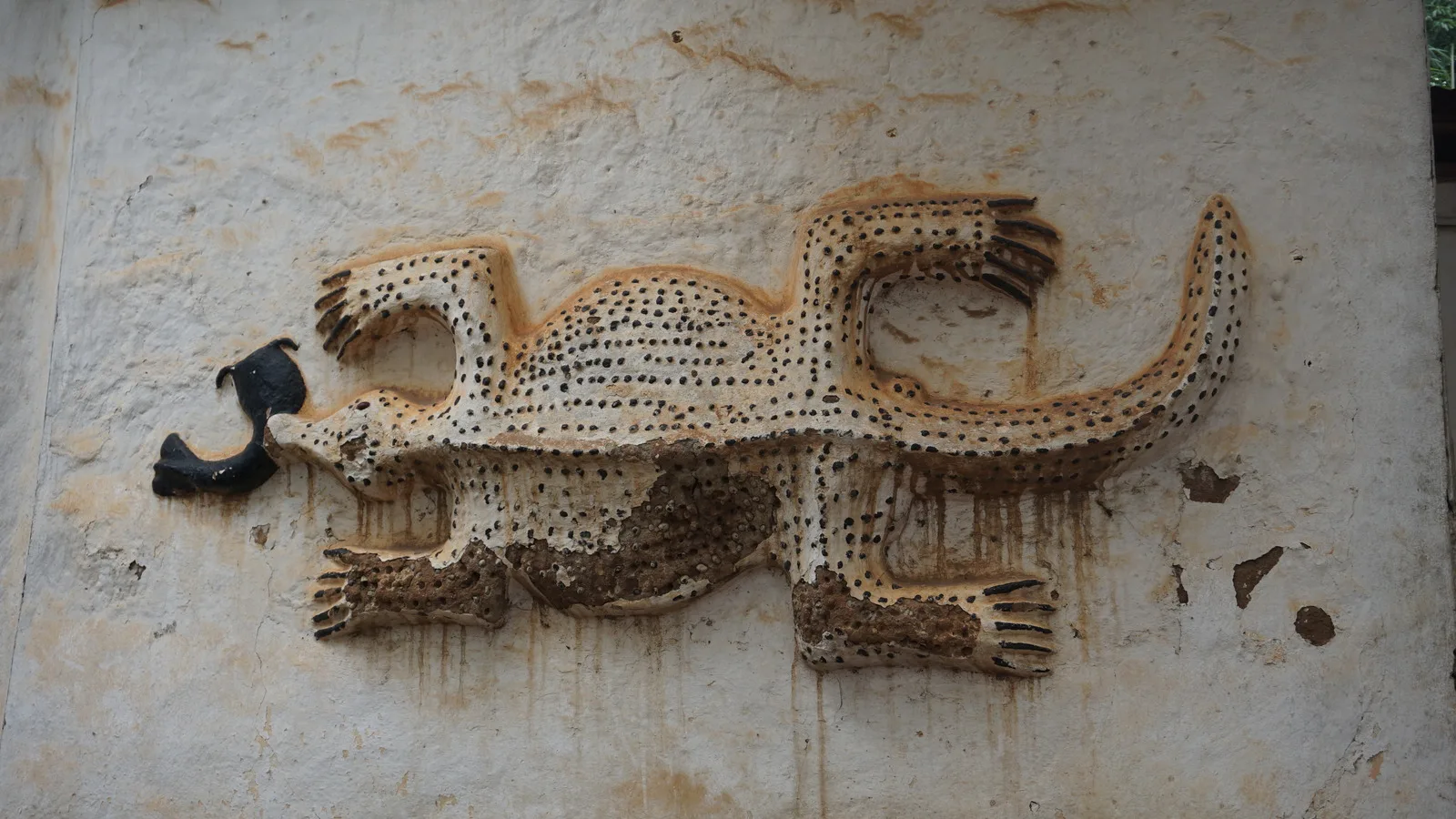
The decoration is the point. Bold bas-reliefs stand out from the walls in a wide range of motifs: spirals and arabesques, and animals, birds and plants, linked to the traditional Adinkra symbols. UNESCO is careful to say that these are not merely ornamental. They carry meanings tied to Asante ideas and beliefs, and they have been handed down from one generation to the next. The photograph at the top of this page is one of them.
Visiting
These are not ruins and they are not a museum. The traditional religion is still practiced in them: people come to consult the deities about a particular situation, or before starting something important. UNESCO points out that this is precisely why the shrines have been kept complete with all their symbolic features. They survive because they are used.
So a visit is a visit to somebody else’s working place of worship, and it is arranged rather than simply undertaken. The Ghana Museums and Monuments Board holds the shrines along with the forts and castles, and keeps a regional office in Kumasi.
Getting there
Kumasi is the base for all of them except Patakro. Beyond that, the honest answer is that you will need local help: the shrines sit in and around villages, several are down roads that are not obvious, and which of them is open on a given day is not a question a page written months earlier can answer.
Charges and opening arrangements are the Ghana Museums and Monuments Board’s to publish, and are deliberately not printed here.
Visiting respectfully
UNESCO records that very few of these buildings are complete, and that in most cases parts of the original structures are missing. The threats it names are heat, humidity, mold and termites, and one that is easy to miss: as farming intensifies, the thatch, the bamboo and the particular timbers the style depends on are getting harder to obtain. The buildings are not only fragile. The materials to mend them are running short.
- Decide which shrine you are going to before you set out. Ten scattered buildings is not one destination
- Ask before photographing, and expect the answer to be no in some parts of a shrine
- Go with the caretaker rather than walking in. Someone is responsible for the building and for what happens in it
- Do not touch the bas-reliefs. The plaster is the irreplaceable part, and it is mud
- If a consultation is taking place, you are a guest at it or you wait outside
- Charges and opening arrangements come from the Ghana Museums and Monuments Board, which is the place to check them
Sources
- UNESCO World Heritage Centre: Asante Traditional Buildings, inscription 35
- UNESCO World Heritage Centre: the two properties inscribed in Ghana
- Ghana Museums and Monuments Board: custodian of the national monuments and sites
Every date, material, motif and shrine name is UNESCO’s own wording for inscription 35, read on 2026-08-16, including its assessment of how much of the property is still standing. Opening arrangements and charges are the Ghana Museums and Monuments Board’s to publish and are not stated here.