Culture
Afar: Human Origins, Salt and Fire in Ethiopia's Rift
Lucy at Hadar, Ardi in the Middle Awash, a salt road walked by camel and a lava lake burning since 1967: what the Afar Depression records, and why three governments currently tell travelers to stay out of it.
- Region East Africa
- Country Ethiopia
- Category Culture
- Reviewed 8 August 2026
- Sources 13
- Length 10 min read
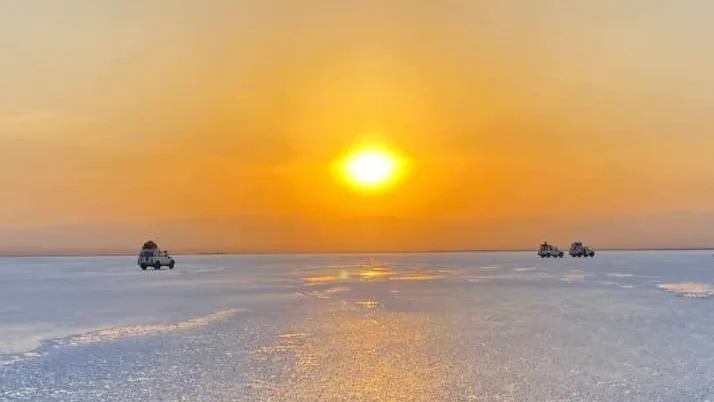
Vehicles on the Danakil salt flats at sunset, in the Afar Depression of northeastern Ethiopia. · Credit Photo: Lucy's Path Tour and Travel
The Afar Depression lies in the northeast of Ethiopia, where the land drops away from the highlands into a floor of salt, ash and lava. It is one of the hardest places in the country to reach and, at present, one of the most strongly advised against. It is also the source of a remarkable share of what is known about the early human past.
That combination is the reason this piece exists. The Afar is routinely introduced to outsiders as an extreme landscape (a stage set of heat and acid and fire), with the people who live in it treated as part of the scenery and the science treated as a curiosity. It is more interesting the other way round: as a place whose geology happens to preserve and expose an unusually legible record, and whose name is attached to the people who have long lived there.
The Afar Depression is not where humanity began. It is where a great deal of the evidence for how it began happens to be readable.
A rift pulling the Horn of Africa apart
The depression sits over a junction in the earth’s crust where the Arabian and African plates are separating, and where the East African Rift runs south. The ground is being stretched and dropped. The Smithsonian Global Volcanism Program, describing the volcano Erta Ale, notes an edifice about fifty kilometers across that rises more than six hundred meters from below sea level in the Danakil depression, a plain reminder that the floor of this place is beneath the sea it no longer touches.
For paleoanthropology this is the whole point. Faulting tilts and exposes ancient lake and river sediments that elsewhere stay buried, and the volcanoes that make the region dangerous also lay down ash horizons that can be dated directly. The result is a sequence in which a fossil can be placed not just in an order but on a timeline.
Hadar, and the skeleton that changed the argument
On 24 November 1974, at the site of Hadar in the lower Awash valley, the fossil that became the most famous individual in paleoanthropology came out of the ground. The Institute of Human Origins at Arizona State University records the find as made by Donald Johanson and Tom Gray; the Smithsonian credits Johanson together with the geologist Maurice Taieb, who co-directed the expedition. Both are describing the same season’s work.
What they recovered, after weeks of screening and sorting, amounted to about 40 percent of a single skeleton, extraordinary for a hominin of that age, and enough to argue from a body rather than from a jaw. The Institute of Human Origins dates the specimen to just under 3.18 million years old using argon-argon dating of the volcanic horizons around it; the Smithsonian gives the rounder figure of about 3.2 million years. She was named for a Beatles song playing in camp the night she was found.
Her species, Australopithecus afarensis, is itself named for the Afar. The Smithsonian dates it from roughly 3.85 to 2.95 million years ago and records it from Ethiopia, Kenya and Tanzania, known from the remains of several hundred individuals. The original Lucy has never gone on tour in the ordinary sense: she is kept in a purpose-built safe in the paleoanthropology laboratories of the National Museum of Ethiopia in Addis Ababa. What is displayed in museums elsewhere, including at the institute that studies her, is a cast.
Ardi, and the question Lucy did not settle
Lucy is not the oldest thing the Afar has produced. Between 1992 and 1994 a team led by Tim White recovered the first fossils of Ardipithecus ramidus in the Middle Awash; in 2009 they announced a partial skeleton, nicknamed Ardi, at about 4.4 million years old.
The naming is worth pausing on, because it is the one place where the science borrows directly from the people whose land it works on. As the Smithsonian sets out, ramid means “root” in the Afar language, chosen for the species’ closeness to the roots of humanity, and Ardi means “ground” or “floor”. The species that anchors one end of the human family tree carries an Afar name.
Ardi also unsettled a tidy story. The long-standing account of why our ancestors stood up held that forests thinned into grassland and walking upright was the adaptation to open country. But Ardi’s bones were found alongside animal remains indicating a wooded environment, which, as the Smithsonian puts it, contradicts the open savanna theory for the origin of bipedalism. The Afar did not just supply the evidence for the old answer. It supplied the evidence against it.
Salt, and the road it travels
The floor of the Danakil is salt, left by an ancient arm of the sea, and it has been cut and carried out of here for a very long time. Salt is quarried by hand into slabs, loaded onto camels, and walked up out of the depression to markets in the highlands. The Ethiopian Ministry of Tourism describes the trade as one of the region’s defining sights.
It is worth being careful here, because this is the part of the Afar that outsiders like most and document least. The sources listed at the foot of this page establish that the trade exists and is old. They do not establish how large it is now, how many animals work it, how long the journey takes, or how much of it has shifted onto trucks. Nor should a reader assume it is a survival: roads, mechanized extraction and, more recently, conflict have all acted on it. It is work, done for a living, in the present tense.
The jile, and what a museum label can and cannot tell you
The best-known Afar object outside Ethiopia is the jile, a curved knife worn at the waist. The Pitt Rivers Museum in Oxford holds three of them: wooden handles, leather sheaths, belts wrapped around, accessioned as PRM 1998.26.21 to 1998.26.23 and given to the museum in 1998 by the traveler Wilfred Thesiger, who had photographed and collected in the region decades earlier.
The museum’s own caption goes further, glossing the leather thongs on the sheaths as a tally of men killed. That line is worth reading as what it is: a note recorded by a British collector about objects acquired in the first half of the twentieth century, preserved because museums preserve what was written at the time. It is evidence of what a collector was told, and when. It is not a description of Afar life in 2026, and it should not be recycled as one.
The submission behind this article included a photograph of a pair of such knives. It is not published here, because its origin could not be established.
Dallol, Erta Ale, and a mountain nobody had recorded erupting
Three features do most of the work in photographs of the Afar, and the Smithsonian Global Volcanism Program is the plainest source on all of them.
Dallol
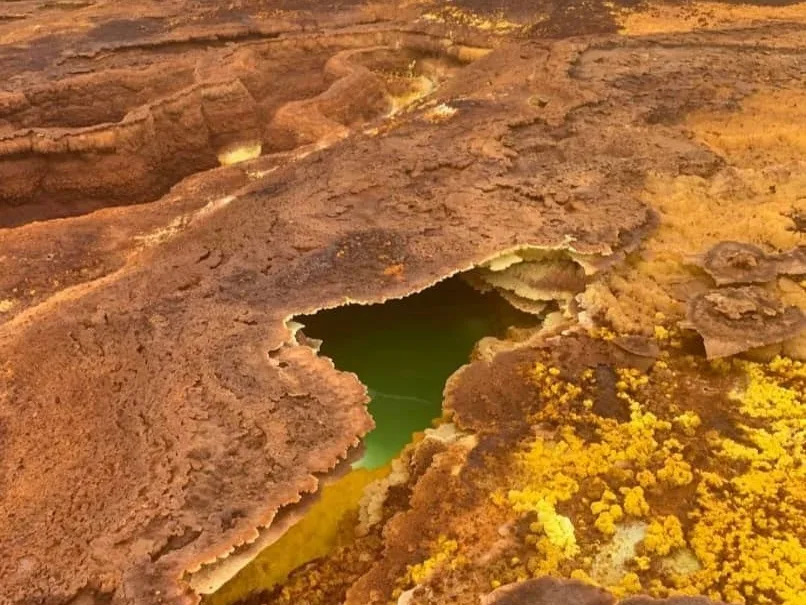
An explosion crater complex sitting at 48 meters below sea level, whose summit crater was formed by a steam eruption in 1926 and whose last recorded activity was in 2011. The colors in every picture of it (the yellows, the greens, the orange crusts) are salts and sulfur laid down by hot brine. A 2019 study in Nature Ecology and Evolution used Dallol to test where life stops: the authors identified physical and chemical barriers beyond which, even with liquid water present at the surface, they found no life.
Erta Ale
A shield volcano in the Afar Rift with a summit at 585 meters. The Global Volcanism Program records the current eruption as ongoing since 1967, with at least one long-lived lava lake in the summit caldera, which is what makes it one of a very small number of places on earth where molten rock can simply be looked at.
Hayli Gubbi
And a reminder that the record is still being written. On 23 November 2025 Hayli Gubbi, a short distance to the south, produced its first explosive eruption ever recorded, with a plume reaching ten to fifteen kilometers. Satellite images taken two days later showed ash across Erta Ale and a newly collapsed area in its northern caldera.
How to check this region for yourself
Not a packing list. A region under a "do not travel" notice calls for verification, and these are the checks that are actually load-bearing.
- Read your own government's current advice for Ethiopia in full, including the regional sections. The headline country level is not the number that applies to Afar.
- Confirm whether the specific area on offer sits inside a "do not travel" zone. As of April 2026 the US State Department names the whole Afar region.
- Check access before anything else. The FCDO records that foreign nationals currently cannot fly into airports in the Afar regional state.
- Ask any operator in writing what security arrangement it uses, and verify it independently rather than taking the answer on trust.
- Treat heat and remoteness as hazards in their own right: basic facilities, no running water, limited medical options.
- Check current volcanic activity through the Smithsonian Global Volcanism Program before relying on any itinerary near Erta Ale or Dallol.
- Re-check all of the above close to the date. Every item here was true on 8 August 2026 and none of it is stable.
Why the record matters even when the road is closed
It would be easy to write the Afar off for now: a place with a magnificent past and a closed present. That would be the wrong lesson. The reason this landscape holds so much of the human record is that it is still tearing itself open, and the same process that lifts four-million-year-old sediment into view is the one that produced an unrecorded eruption in November 2025.
The fossils are in Addis Ababa. The literature is public. The people whose language named the species are living there now, working salt and keeping animals, under conditions that have more to do with politics than with heat. Knowing the place properly does not require standing in it, and at the moment, three governments would rather you did not.
Sources and further reading
- UNESCO World Heritage Centre: Lower Valley of the Awash
- Smithsonian Human Origins Program: Australopithecus afarensis
- Smithsonian Human Origins Program: AL 288-1 (Lucy)
- Smithsonian Human Origins Program: Ardipithecus ramidus
- Institute of Human Origins, Arizona State University: Lucy's Story
- Smithsonian Global Volcanism Program: Erta Ale
- Smithsonian Global Volcanism Program: Dallol
- Smithsonian Global Volcanism Program: Hayli Gubbi
- Belilla and others, Nature Ecology and Evolution, 2019: life limits at Dallol
- Pitt Rivers Museum, University of Oxford: Wilfred Thesiger in Africa
- Visit Ethiopia, Ethiopian Ministry of Tourism: Danakil Depression
- US Department of State: Ethiopia Travel Advisory, April 2026
- UK Foreign, Commonwealth and Development Office: Ethiopia: regional risks
Facts were checked against the following sources, accessed 8 August 2026.