Events and Festivals
Ghana Festivals and Celebrations
Homowo hoots at hunger and Aboakyer opens with a live hunt. What Ghana’s festivals are for, when they fall, and how to attend one well.
- Country Ghana
- Category Events and Festivals
- Reviewed 16 August 2026
- Sources 4
- Length 3 min read
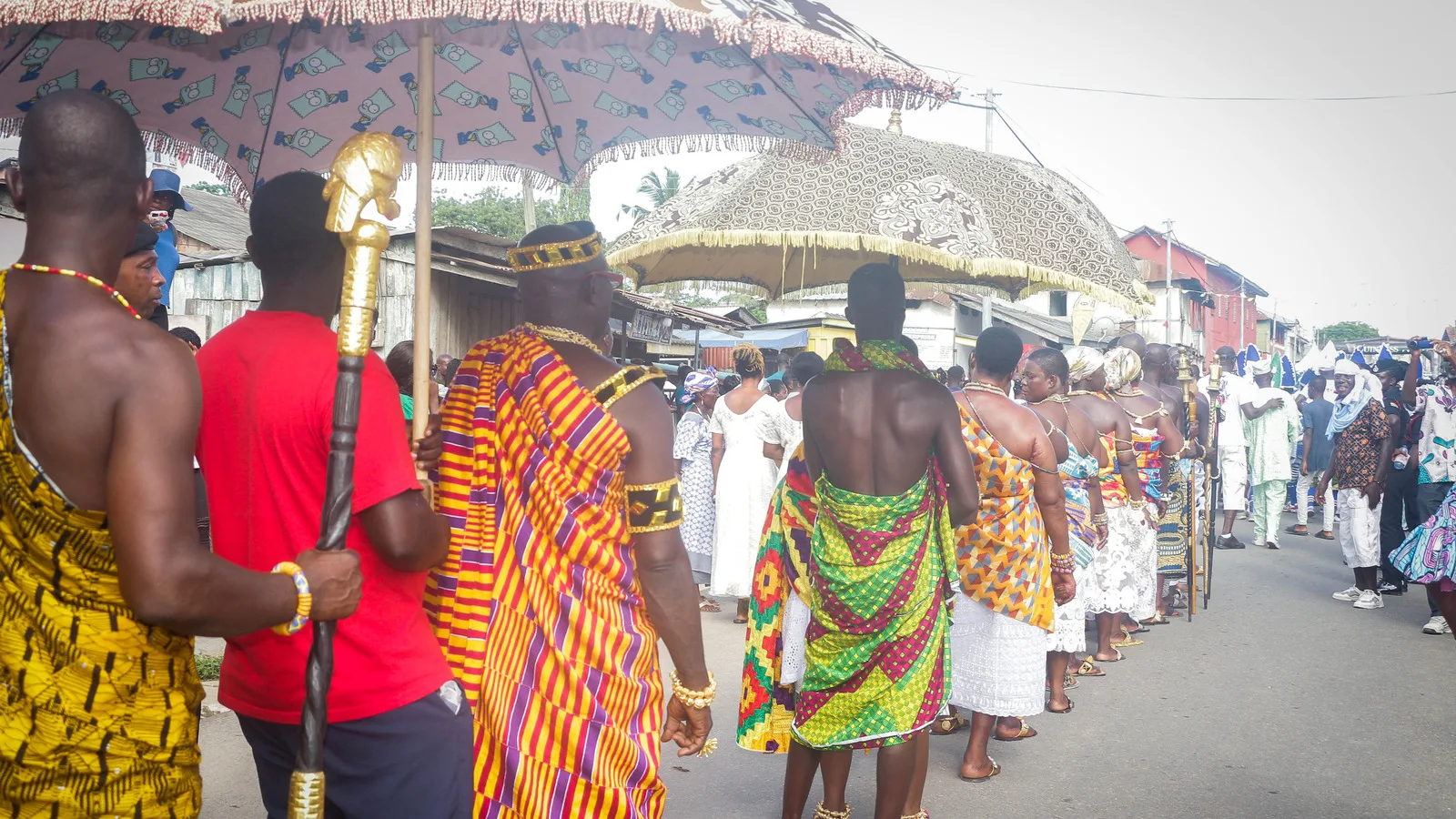
Credit Fquasie, CC BY-SA 4.0, via Wikimedia Commons
A Ghanaian festival is not a performance that happens to have an audience. It is a civic and religious occasion with a purpose, usually involving chiefs, usually involving the ancestors, and usually the same week every year for reasons that predate anyone who will be there. Visitors are welcome. Visitors are not the point.
The major festivals
Homowo belongs to the Ga of the Greater Accra Region and its name translates as hooting at hunger. It commemorates a famine the Ga survived, and it answers that memory with abundance and mockery rather than solemnity. It falls in the second half of the year and is preceded by a ban on drumming and noise, which is observed seriously.
Aboakyer is held by the Effutu of the Winneba Traditional Area on the first Saturday in May. Two companies of hunters go out to catch a live antelope, and the origin is a substitution: the god Otu is said to have asked for a member of the royal family, and the people asked to give an animal instead, on the condition it was taken alive. The festival marks the Effutu migration and asks for a good harvest.
Akwasidae is the Asante observance at the Manhyia Palace in Kumasi, held every six weeks on a Sunday. Because it recurs rather than falling once a year, it is the great Asante occasion a short trip can realistically be planned around.
Not with arrogance, but with memory. Not with excess, but with survival.Ghana Tourism Authority, on what Homowo is doing when it hoots at hunger
Regional celebrations
Beyond the largest, almost every traditional area has its own. Kpledjoo is the harvest festival of the chiefs and people of Tema. Damba is observed across the north on the Islamic calendar, which means it moves through the solar year rather than sitting in a fixed month. Coastal towns hold their own durbars and homecomings.
Do not treat a regional festival as a lesser version of a national one. It is often the opposite: smaller, less used to outsiders, and considerably closer to the thing itself.
Planning a visit around a festival
Dates are the difficulty. Some festivals sit on a fixed rule you can rely on, like the first Saturday in May. Others are set by a traditional council closer to the time, or move with the lunar calendar, and are announced weeks rather than months ahead. Do not book a non refundable trip against a date you found on a blog.
Check the Ghana Tourism Authority calendar, and where you can, ask the traditional council or a local guide directly. Book accommodation early in a festival town, because everyone with a connection to that place is also coming home. Expect the published start time to be the time things begin to begin.
Attending respectfully
- Ask before photographing anyone, and accept a refusal without negotiating it
- Never photograph a chief, a shrine or a ritual object without explicit permission
- Dress as if for a serious public occasion, with shoulders and knees covered
- Stand when the crowd stands, and follow the crowd on where not to walk
- Do not stand in front of people who have come for this, in order to film it
- If a period of silence or a ban on drumming is in force, it applies to you too
- A local guide is worth paying for, and will keep you from three mistakes before noon
Sources
- Ghana Tourism Authority: the Aboakyer festival at Winneba
- Ghana Tourism Authority: the Homowo festival
- Ghana Tourism Authority: the current events calendar
- Ghana Museums and Monuments Board: custodian of Ghana material cultural heritage
Festival dates are set by traditional authorities and the tourism authority calendar is the practical place to confirm a current edition. No specific year is given on this page, because a date written here would expire without any sign that it had.