Heritage
An Introduction to Egypt
A Cairo tour operator on the country he works in
- Region North Africa
- Country Egypt
- Category Heritage
- Reviewed 11 August 2026
- Sources 16
- Length 4 min read
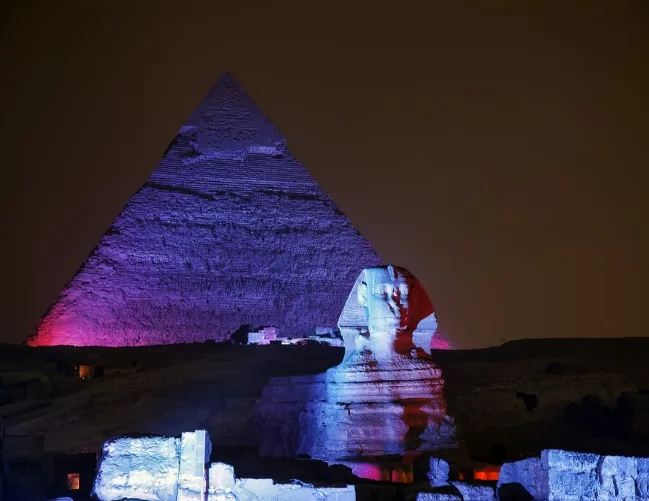
The Great Sphinx and the pyramid of Khafre during the evening sound-and-light show. · Credit Supplied by Elshams Travel
Egypt is located in the northeast corner of Africa, and connects to Asia across the Sinai Peninsula, the Egyptian part of which lies in southwest Asia. It is bordered by the Mediterranean Sea to the north, Palestine and Israel to the northeast, Sudan to the south, and Libya to the west. Cairo is the capital of Egypt and one of the largest cities in Africa, a leading cultural city located very close to the most famous monuments ever known on earth: the three pyramids and the Sphinx.
Thousands of years ago a very civilized people lived in the Nile valley. They cultivated land, raised cattle, and built monuments that remain glorious, telling us about people who were rulers of the ancient world at a time when most of the people of the world were still trying to find their way in the dark.
Ancient beliefs and the pyramids
From the beginning of their history, ancient Egyptians believed in life after death. They could not imagine their future life as essentially different from their life on earth, and that is exactly why they excelled at mummifying their bodies. A visitor to Egypt can see a great many ancient Egyptian mummies. They believed the body had to be well preserved, and that this was necessary to the well-being of the dead person at resurrection. This leads us to the real reason for building the pyramids: ancient Egyptians built them as tombs for their dead kings, and later the right was extended to queens as well.
If you ask a world traveler which famous monument made the strongest impression on them, they will probably reply the pyramids of Egypt. The reasons differ. One visitor may admire their colossal scale, another their antiquity, a third their architectural perfection, a fourth their setting. When you visit the area on very dark nights, you will discover that there is no limit to their inspiring beauty by night. People are cheerful and noisy when they visit the pyramids by day, but at night the beauty of the site and the realization of its antiquity turn the frivolous visitor into a serious admirer.
Whenever the pyramids are mentioned, that of Khufu (the Great Pyramid of Giza) springs to mind, but visitors to Egypt may see many others at the edge of the plateau west of Cairo, and there are others as far south as Sudan. Altogether there are more than seventy known pyramids in Egypt, and nobody can estimate how many lie hidden under the sand of the desert.
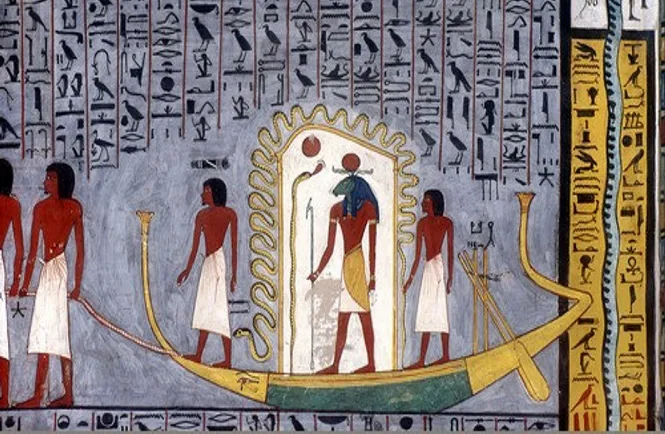
Those triangular shapes loom up against the sky to connect heaven and earth.
Egypt today
Egypt is a developing country with the second-largest economy in Africa. It is considered a regional power in the Middle East, North Africa and the Muslim world, and a middle power worldwide. Islam is the official religion and Arabic the official language. Egypt is a founding member of the United Nations, the Non-Aligned Movement, the Arab League, the African Union, the Organization of Islamic Cooperation and the World Youth Forum.
A visitor to Egypt can enjoy an unforgettable cultural experience visiting the great ancient monuments scattered all over the country, taking in a wide variety of ancient civilizations, starting from the Pharaonic monuments, passing through the Greco-Roman landmarks, and ending with the Coptic and Islamic periods. You can easily combine a cultural tour with a recreational and relaxing stay on one of the magnificent shores of the Red Sea, at Hurghada or Sharm El Sheikh, where you can swim, dive, snorkel, sail and windsurf.
Egyptian people and tourism
Egypt has a long and great history that extends more than 7,000 years, recording one of the oldest civilizations ever known on earth. Egyptian people are very hospitable and peaceful; they almost always smile at their guests everywhere in Egypt, and visitors appreciate that. A visit to Egypt means diving into a long history and an ancient way of life. Ancient Egyptians were not only the builders of these monuments; they were human beings like us, with their own religious ideas, their likes and dislikes, and behaviors and habits much like ours.
The best time to visit Egypt is from October until the end of May, as the weather is hot during the summer months from June to the end of September. The official currency is the Egyptian pound; check the rate of exchange when you arrive. The international dialing code is +20, and tourists can use credit or debit cards for shopping throughout Egypt.
Sources and further reading
- Ahmed Fakhry, The Pyramids, University of Chicago Press, 1961
- Presidency of the Arab Republic of Egypt: About Egypt
- Egyptian Ministry of Tourism and Antiquities: Giza Plateau
- Egyptian Ministry of Tourism and Antiquities: The Great Pyramid
- Egyptian Ministry of Tourism and Antiquities: Predynastic Period
- The Metropolitan Museum of Art: Tutankhamun's Funeral, by Dorothea Arnold
- World Bank: Egypt, Arab Rep. country data
- World Bank: World Bank Country and Lending Groups
- United Nations: Egypt, Member States
- African Union: Egypt
- Organisation of Islamic Cooperation: Member States
- Non-Aligned Movement: History
- World Youth Forum: About Us
- Egyptian Tourism Authority: Useful Information
- Central Bank of Egypt: Exchange Rates
- Smithsonian Institution: The Egyptian Pyramid
Facts were checked against the following sources, accessed 11 August 2026.