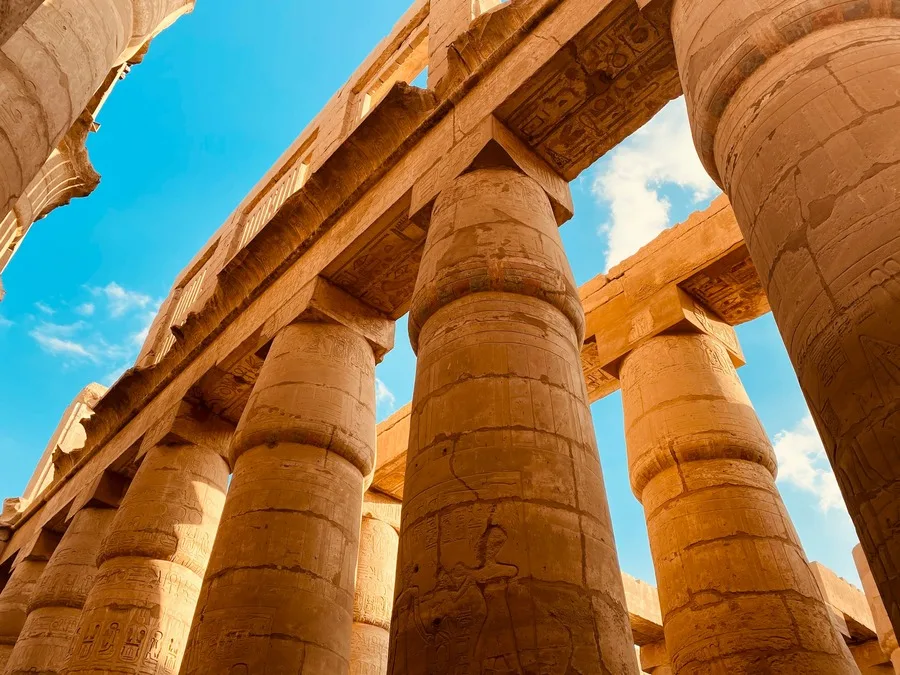
Egypt
Three thousand years of monuments, and a country that did not stop there
- Region North Africa
- Country Egypt
- Type Country
- Reviewed 28 July 2026
- Sources 3
- Length 3 min read
Credit Unsplash
Why Egypt
Egypt has the problem of being too famous. The pyramids at Giza and the tombs of the Valley of the Kings are so thoroughly reproduced that arriving can feel like checking a photograph. They are, nonetheless, worth the journey. The scale does not survive reproduction.
The more interesting trip treats pharaonic Egypt as one layer among several. Coptic Cairo holds churches built on foundations older than Islam. Islamic Cairo is a dense working quarter of mosques, madrasas and markets, much of it medieval. Alexandria was a Greek city. Nubia, in the far south, has its own language, architecture and history.
The Nile as a working river
It is easy to experience the Nile only as a cruise route between Luxor and Aswan. That stretch is genuinely rich (Karnak, Luxor Temple, the Valley of the Kings, Edfu, Kom Ombo, Philae), but the river is also the reason Egypt exists, and almost the entire population still lives within a few kilometers of it.
A felucca under sail moves at the speed the river has always moved. It is a different experience from a cruise deck, and worth a day.
Nubia
South of Aswan the country changes. Nubian villages on Elephantine Island and along the west bank are painted in strong color, and the Nubian language is unrelated to Arabic. Much of historic Nubia was flooded by Lake Nasser when the Aswan High Dam was completed in 1970, displacing communities and requiring the relocation of Abu Simbel stone by stone.
That displacement is living memory. It is part of the story of the dam.
Cairo
Cairo is enormous, loud, and rewards a slower approach than most itineraries allow. The Egyptian Museum, the Grand Egyptian Museum at Giza, the Citadel, Khan el-Khalili, the City of the Dead, and the Coptic quarter each deserve their own half-day.
Practical orientation
Arabic is the official language; English is widely used in tourism. The currency is the Egyptian pound. Summer in Upper Egypt is severely hot: Luxor and Aswan regularly exceed 40°C between June and August. October to April is far more comfortable.
Dress modestly at religious sites, for both men and women. Entry requirements vary by nationality. Check the official source before you travel.
Sources and references
- UNESCO World Heritage Centre: Ancient Thebes with its Necropolis
- UNESCO World Heritage Centre: Nubian Monuments from Abu Simbel to Philae
- UNESCO World Heritage Centre: Historic Cairo
These are the authoritative references for the World Heritage sites this page discusses; each was checked at source on 10 August 2026. Practical details (entry rules, health guidance, opening times) change constantly. The bodies listed here are authoritative and this page is not.