Events and Festivals
Morocco Festivals and Celebrations
Morocco marks its year with moussems, harvests and horses. Tbourida and the cherry festival at Sefrou are both inscribed by UNESCO in their own right.
- Country Morocco
- Category Events and Festivals
- Reviewed 19 August 2026
- Sources 4
- Length 2 min read
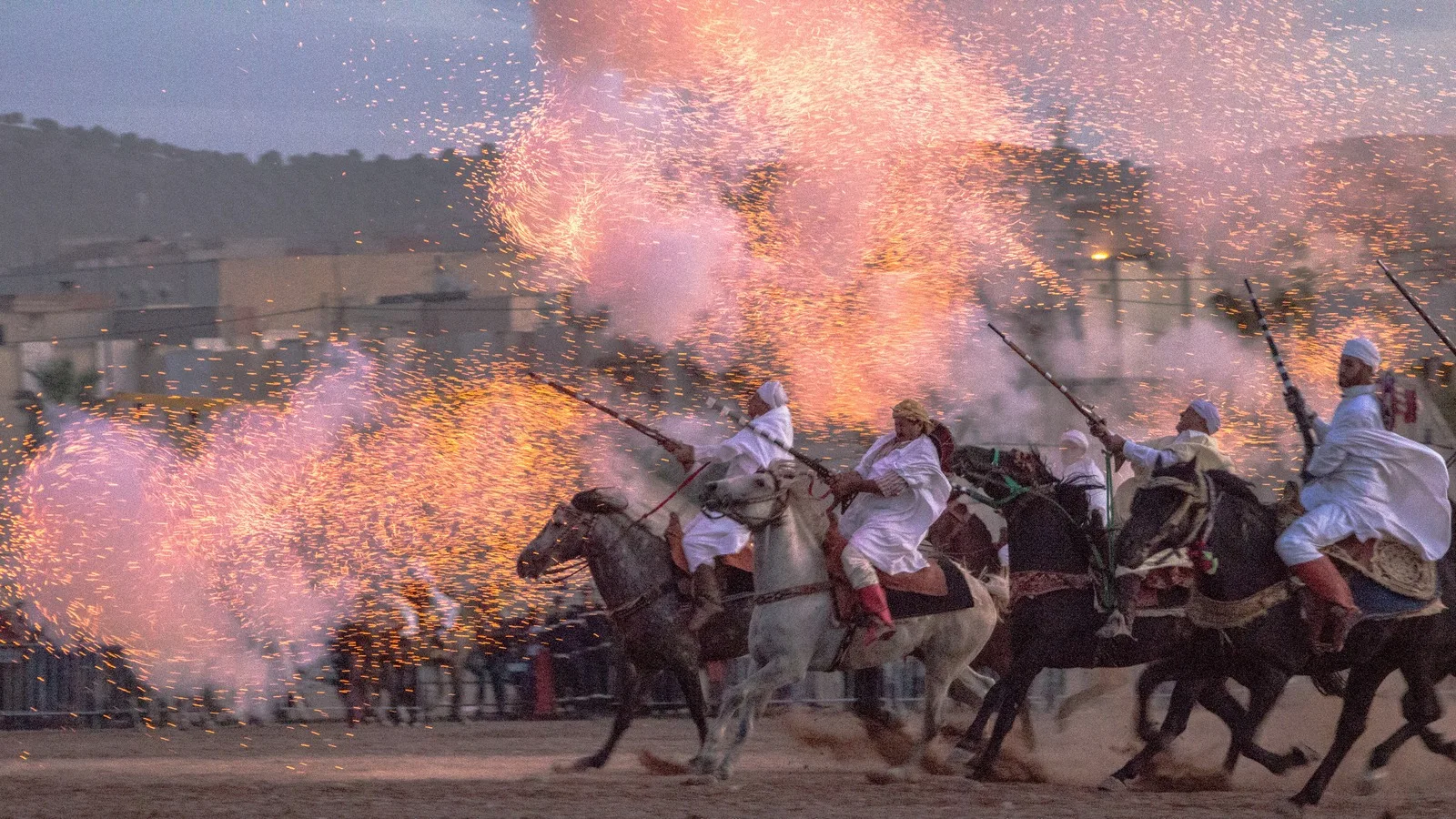
Credit Farajiibrahim, CC BY-SA 4.0, via Wikimedia Commons
Morocco does not keep its festivals in a cultural quarter. The calendar is made of moussems, which are pilgrimages to a saint's shrine that became fairs, of harvests that became town festivals, and of an equestrian performance that is judged as seriously as any sport.
Tbourida
Tbourida is the one most visitors have seen a photograph of without knowing its name: a line of riders in matching dress charging together and discharging their muskets in a single volley, so that the sound arrives as one shot and the smoke closes over the field. It is inscribed on the UNESCO Representative List. It is performed at moussems and at dedicated festivals through the summer, and it is competitive: a troupe is judged on the discipline of the line and the unity of the volley rather than on speed.
Moussems and harvests
The Moussem of Tan-Tan, in the far south, is inscribed as a gathering of nomadic and Saharan communities, a meeting that was originally about trade, marriage, arbitration and pasture as much as about celebration. The cherry festival at Sefrou, near Fez, is inscribed too, and is what it sounds like: a town marking its harvest, with a procession, and with an economy behind it.
Elsewhere the pattern repeats without an inscription attached. There is a rose harvest in the Dades valley, a date harvest in the southern oases, and a great many local moussems that are not on any tourist calendar and are the better for it.
If you are planning around a festival
No dates are printed here on purpose. A date published a year ahead is wrong more often than it is right.
- Confirm dates directly with the organizer or the tourist office. Most are set locally and move.
- Moussems follow the Islamic calendar, so their position in the solar year shifts.
- Book accommodation early in small towns. A moussem fills them.
- Expect crowds, and expect roads into the town to be slow on the day.
- Ask before photographing performers and participants, and accept a refusal.
Sources and references
- UNESCO Intangible Cultural Heritage: Morocco
- UNESCO Intangible Cultural Heritage: Gnawa
- Moroccan National Tourist Office
- Kingdom of Morocco: official national portal
Tbourida, the Moussem of Tan-Tan, the cherry festival in Sefrou and Gnawa are all on the UNESCO Representative List. The list was read at source on 19 August 2026 through the intangible heritage register for Morocco.