Morocco
Nine World Heritage sites, and every one of them is something people built
- Region North Africa
- Country Morocco
- Type Country
- Reviewed 11 August 2026
- Sources 4
- Length 4 min read
Credit Toa Heftiba, Unsplash
Why Morocco
Morocco is sold as landscape: the dunes, the Atlas passes, the road south. Its World Heritage record says something else. UNESCO lists nine properties here and classes all nine as cultural, with not one natural inscription among them. What the country has put forward, and what has been accepted, is a record of building: medinas at Fez, Marrakesh, Essaouira and Tétouan, a Roman town at Volubilis, a Portuguese fortress port, earthen villages on the pre-Saharan slopes, and Rabat, inscribed as a shared heritage in which modernist planning was adapted to the Maghreb inside a city that already had a medina, a kasbah and an Almohad wall. Read that way, Morocco is less a landscape with towns in it than an argument about how to live in a hot, dry, defensible place.
Fez, and ten centuries of it
Fez was founded by the Idrisid dynasty between 789 and 808, in two fortified quarters facing each other across the Fez wadi: the bank of the Andalusians and the bank of the Kairouanese. The Almoravids brought them inside a single rampart in the eleventh century, the old town reached its present size under the Almohads, and in 1276 the Merinids founded a second town beside it, Fez Jedid, holding the royal palace and the army headquarters.
UNESCO calls the result one of the most extensive and best conserved historic towns of the Arab-Muslim world, built with construction techniques and decoration developed over more than ten centuries, in which local knowledge is interwoven with Andalusian, Oriental and African inspiration. The unpaved streets still carry most of the functions they were laid out for.
The ksar, and what earth can do
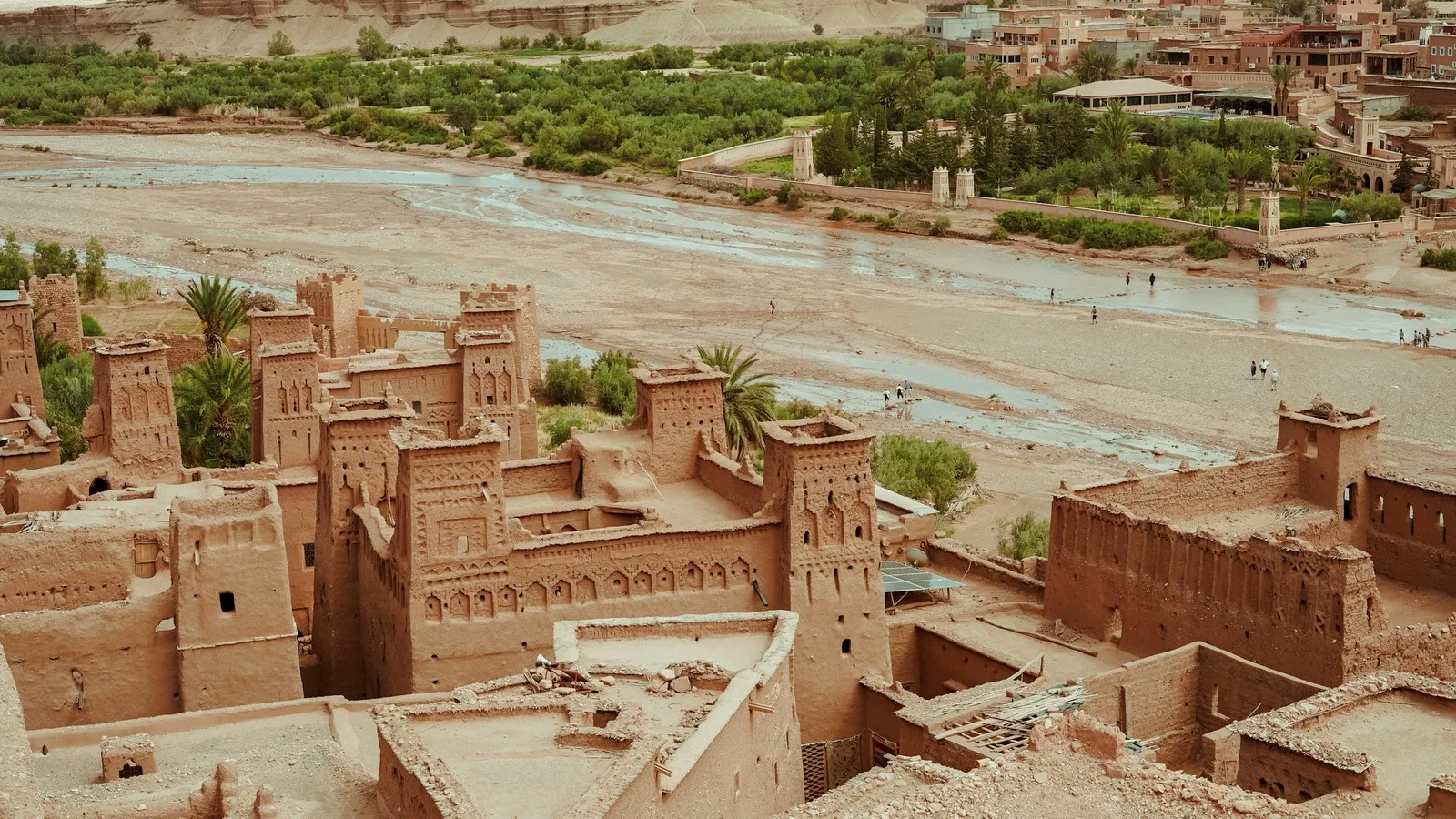
Ait Ben Haddou stands in the Ounila valley on the southern slopes of the High Atlas. It is a ksar: houses crowded inside a defensive wall reinforced by angle towers and entered through a baffle gate, some modest, some closer to small urban castles with upper walls worked in clay brick. UNESCO calls it a complete panorama of pre-Saharan earthen construction technique.
Its oldest buildings are no earlier than the seventeenth century, although the technique was spreading through the southern valleys long before. The village was one of many trading posts on the route from ancient Sudan to Marrakesh by the Dra valley and the Tizi-n’Telouet pass, and it holds a mosque, a public square, threshing floors outside the ramparts, a caravanserai, a saint’s sanctuary and two cemeteries, one Muslim and one Jewish.
Food
A tagine is the pot, not the dish, and what comes out of it changes with the season and the house: lamb with prunes and almonds, chicken with preserved lemon and olives. Couscous is steamed three times rather than boiled, and in many households it is what Friday is for. Mint tea is poured from a height to aerate it, and is offered often enough that refusing all of it is harder than accepting some.
Practical orientation
Arabic and Amazigh are the official languages, French does a great deal of business, and Spanish is common in the north. The currency is the dirham. Spring and autumn are the comfortable seasons; the interior and the south are severe in high summer.
Entry requirements and health guidance vary by nationality and change. The Ministry of Foreign Affairs is the authority on them, and this page is not.
Sources and references
- UNESCO World Heritage Centre: Medina of Fez
- UNESCO World Heritage Centre: Ksar of Ait-Ben-Haddou
- UNESCO World Heritage Centre: Rabat, Modern Capital and Historic City
- Ministry of Foreign Affairs, African Cooperation and Moroccan Expatriates
These are the authoritative references for the heritage this page discusses; each was checked at source on 11 August 2026. Practical details (entry rules, health guidance, opening times) change constantly. The bodies listed here are authoritative and this page is not.