Heritage
Thimlich Ohinga: Visitor and Heritage Guide
Dry stone walls up to four and a half meters high, laid without mortar in the sixteenth century, in the hills northwest of Migori.
- Country Kenya
- Category Heritage
- Reviewed 16 August 2026
- Sources 3
- Length 2 min read
Credit Wycondi, CC BY-SA 3.0, via Wikimedia Commons
Thimlich Ohinga is a long way from anything else in this guide, and it is worth the detour for a reason that takes a moment to land: the walls are held up by nothing. No mortar, no cement, no binding of any kind. They have stood for something close to five centuries on nothing but the accuracy with which the stones were fitted to each other.
What was inscribed
UNESCO added the site to the World Heritage List in 2018. It sits 46 kilometers northwest of Migori Town, in the Lake Victoria region, and UNESCO dates the settlement to probably the sixteenth century.
An ohinga is a settlement. This one is the largest and best preserved of a tradition of massive dry stone walled enclosures built by the pastoral communities of the Lake Victoria basin, a tradition that persisted from the sixteenth century to the middle of the twentieth. The enclosures served as security for people and for livestock, and they also marked out social units and relationships of lineage. They were a way of organizing a society as much as a way of defending it.
What you will see
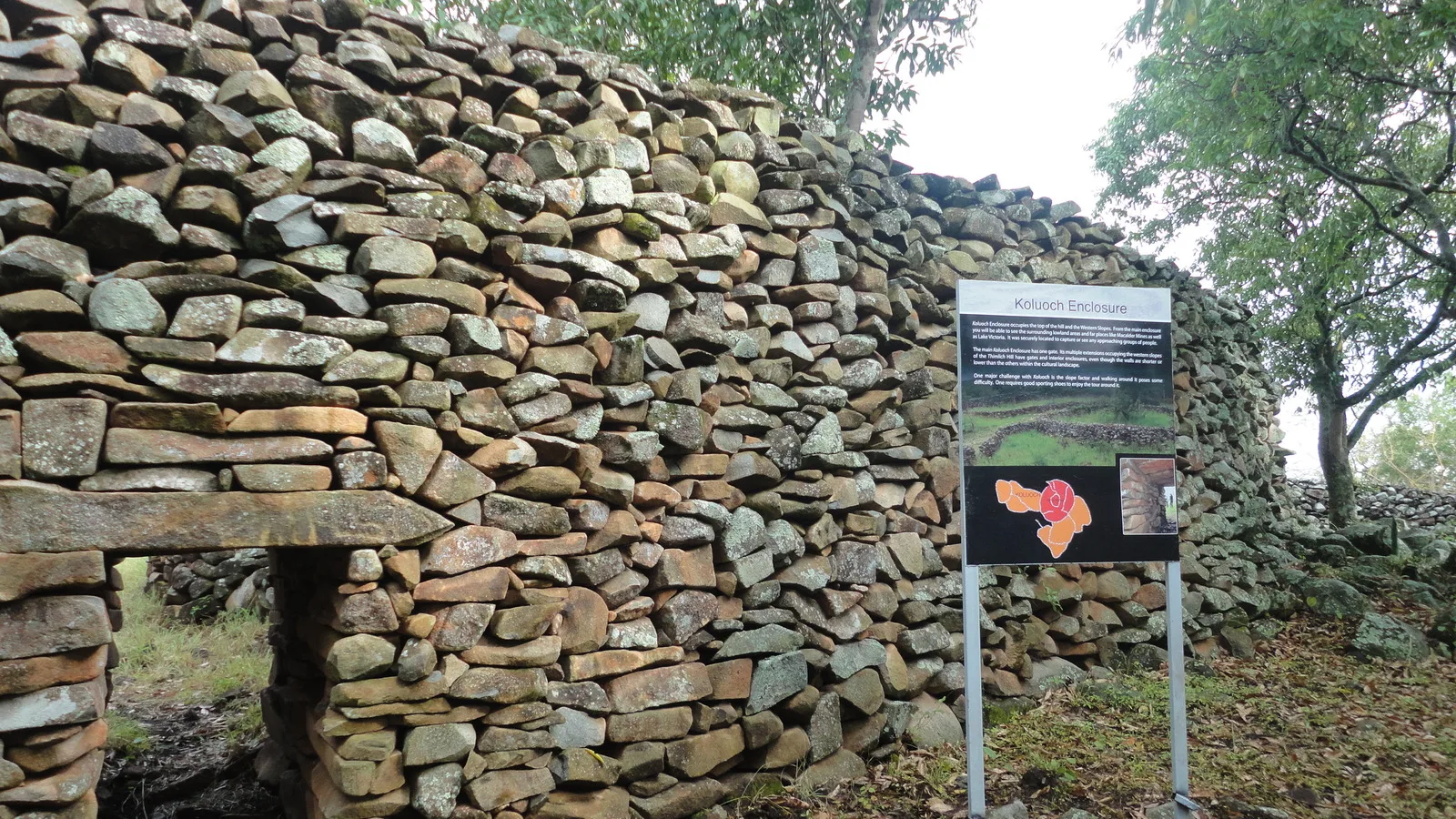
The property holds four larger enclosures, all of them with extensions. The main one is Kochieng, and the others are Kakuku, Koketch and Koluoch. The wall in the photograph at the top of this page is Kochieng.
The walls run from about one and a half to four and a half meters high and average roughly a meter thick. Look closely at a section and the method shows: a separately built outer face and inner face, held together by a middle phase between them, with the stones placed in an interlocking arrangement that gives the whole wall its stability. Nothing was quarried square. The fit was found rather than imposed.
Getting there
This is the honest part. Thimlich Ohinga is in the far southwest, near Lake Victoria, and it is not on the way to the coast, the Mara or Nairobi. Treat it as a deliberate destination rather than a stop, and give it a day.
The site is in the care of the National Museums of Kenya, which publishes the current opening arrangements and charges. Those are not printed here, because a page written months before you read it is the wrong place to learn them.
Worth knowing before you go
- The interest here is craft and settlement, not monumentality. Give yourself time to look at how a wall is actually built
- There is no mortar anywhere on the site, which also means the walls are more fragile than they look. Do not climb on them
- Four enclosures, not one. Kochieng is the main one and the others are close by
- The tradition this belongs to ran for four hundred years, so what you are looking at is a practice rather than a single event
- The setting is rural and open. Sun and water matter more here than they do on a city day
Sources
- UNESCO World Heritage Centre: Thimlich Ohinga Archaeological Site, inscription 1450
- UNESCO World Heritage Centre: the eight properties inscribed in Kenya
- National Museums of Kenya: custodian of the national heritage sites
Every date, dimension, enclosure name and description of the wall construction is UNESCO’s own wording for inscription 1450, read on 2026-08-16. Opening hours and fees are the National Museums of Kenya’s to publish and are deliberately not stated here.