Cameroon
Three World Heritage sites, and current travel advice closes the regions holding two of them
- Region Central Africa
- Country Cameroon
- Type Country
- Reviewed 13 August 2026
- Sources 5
- Length 4 min read
Credit Earwig, via Wikimedia Commons
Why Cameroon
Cameroon is often introduced as Africa in miniature, on the grounds that desert, savanna, mountain, rainforest and coast all occur inside one set of borders. The geography is real. The phrase flattens it.
What the three inscriptions actually cover is one archaeological landscape in the far north, one rainforest reserve in the south, and one share of a park that spans three countries. Read the advisory block above before planning around any of them.
The Dja Faunal Reserve
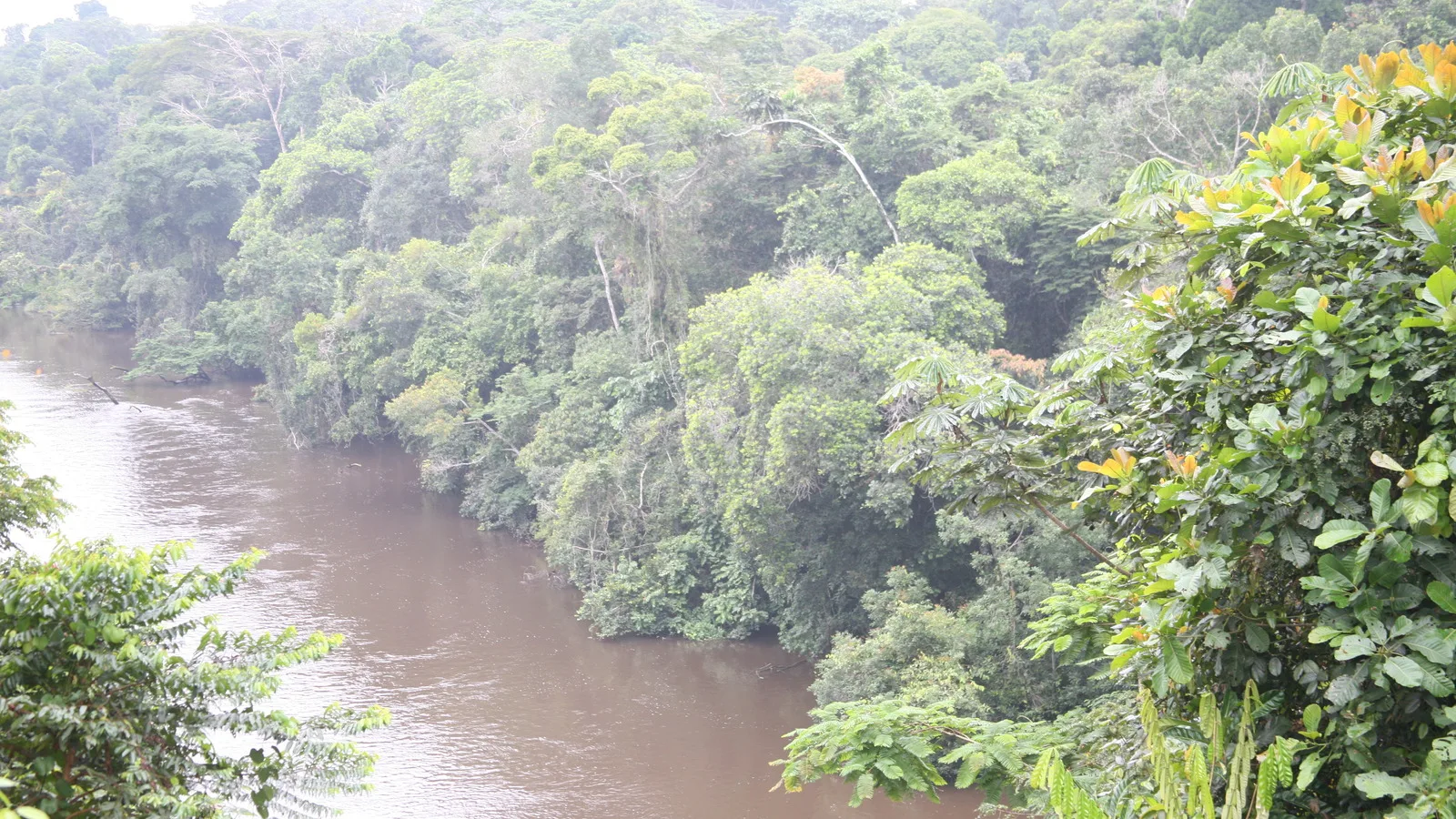
Dja is one of the largest and best protected rainforests in Africa and is almost entirely enclosed by a loop of the Dja river, which forms a natural boundary around it. The photograph at the top of this page is that river near Somalomo, on the northern edge.
It is the property in Cameroon that this page can talk about as a destination rather than as a fact, and the practical difficulty is access rather than permission: it is deep forest, and getting into it is an expedition rather than a drive.
Sangha Trinational, described and not recommended
Sangha Trinational is three contiguous national parks totaling around 750,000 hectares in the northwestern Congo Basin, at the point where Cameroon, the Central African Republic and the Republic of the Congo meet. Much of it is unaffected by human activity.
It holds forest elephants, the critically endangered western lowland gorilla and the endangered chimpanzee, along with Nile crocodiles and the goliath tigerfish. The clearings inside the forest support their own herbaceous species, and UNESCO reads the whole property as a place where ecological and evolutionary processes have continued at enormous scale.
The Cameroonian share of it is inside the 20 kilometer border band the current advisory closes. The Republic of the Congo holds another share, and its own advisory is much milder.
Food
Ndole is the dish people name first: bitterleaf cooked down with ground peanut and either fish or beef, served with plantain. Eru is the forest leaf stew of the southwest. On the coast the fish is grilled whole with pepper and lime, and in the north the food shifts toward millet and toward the Sahel.
Practical orientation
French and English are both official, which is a fact with more history behind it than a language list suggests. Douala has the largest airport and Yaounde is the capital. Cameroon holds four elements on UNESCO’s intangible heritage lists, among them Ngondo, the worship of water oracles among the Sawa, and Mvet Oyeng, which it shares with Gabon and the Republic of the Congo.
Cameroon operates an official electronic visa portal. Requirements vary by nationality and change, and that portal is the authority on them, not this page.
This page states no entry, health or security requirements, and is not advice. Check your own government’s current guidance before making any decision.
Sources and references
- UNESCO World Heritage Centre: Cameroon, States Parties
- UNESCO World Heritage Centre: Diy-Gid-Biy Cultural Landscape of the Mandara Mountains
- UNESCO World Heritage Centre: Sangha Trinational
- UNESCO Intangible Cultural Heritage: browse the Lists
- evisa Cameroun: official visa application portal
These are the authoritative references for the heritage this page discusses; each was checked at source on 13 August 2026. Practical details (entry rules, health guidance, opening times) change constantly. The bodies listed here are authoritative and this page is not.