Gabon
Eighteen hundred rock carvings on a road people took three thousand years ago
- Region Central Africa
- Country Gabon
- Type Country
- Reviewed 13 August 2026
- Sources 4
- Length 4 min read
Credit US Forest Service, public domain, via Wikimedia Commons
Why Gabon
Gabon is mostly forest. Something close to nine tenths of it, and the country has built a good deal of its recent international identity on protecting that.
It holds two World Heritage properties: Ivindo National Park, inscribed for its rivers and waterfalls, and the Ecosystem and Relict Cultural Landscape of Lope-Okanda, which is the reason this page leads where it does.
Lope-Okanda
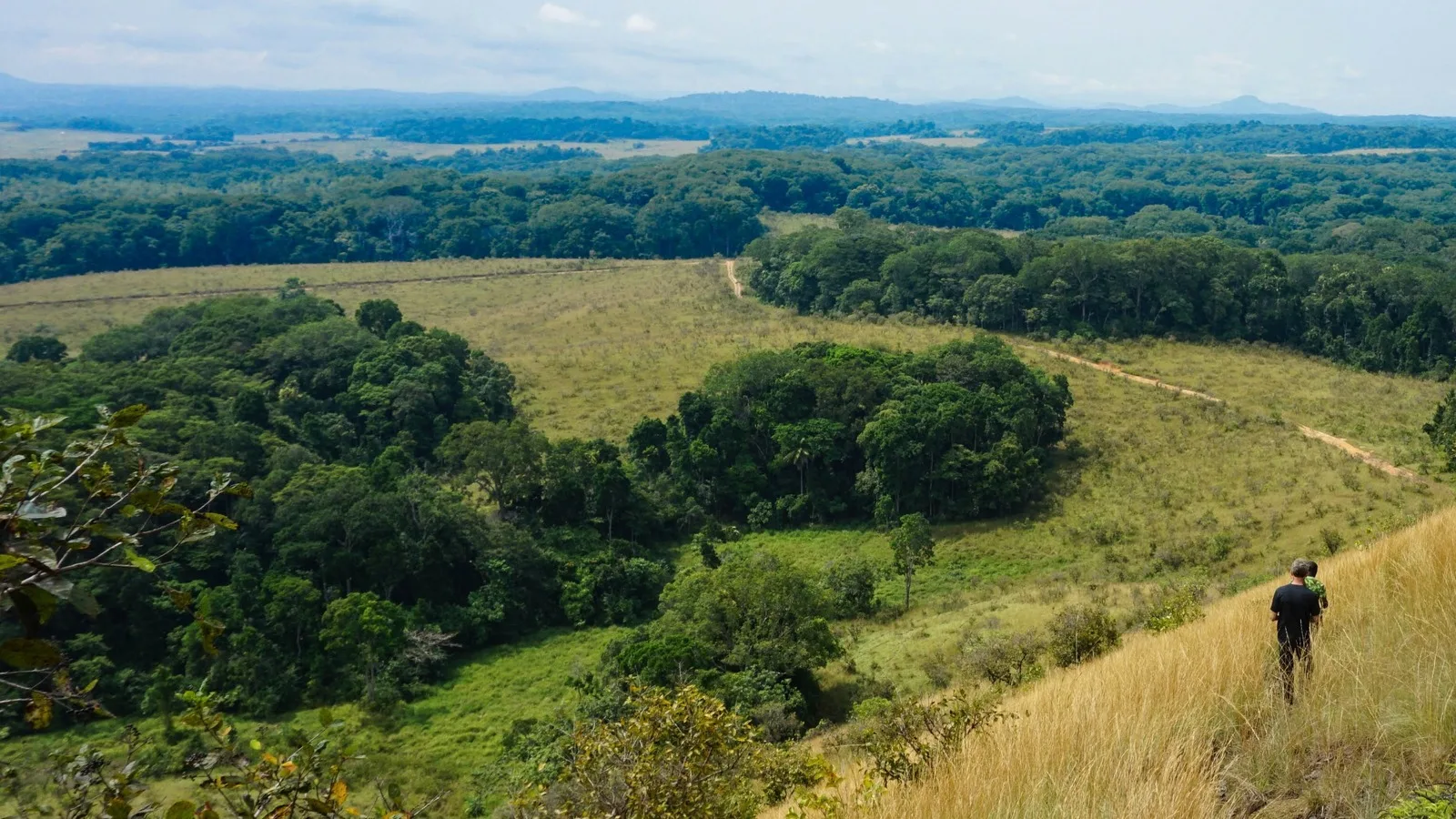
Lope-Okanda is inscribed as both an ecosystem and a cultural landscape, and the two arguments hold each other up. Ecologically it is an unusual interface: dense, well conserved tropical rainforest meeting relict savanna, the savanna a leftover of an older, drier climate that the forest has not finished reclaiming. The photograph at the top of this page is that boundary, with islands of forest standing in grass.
Culturally it holds the remains of successive peoples: habitation around hilltops, caves and shelters, evidence of iron working, Neolithic and Iron Age sites, and a collection of some 1,800 petroglyphs.
What UNESCO says those add up to is the part worth sitting with. The valley of the Ogooue was a major migration route for Bantu and other peoples moving from West Africa, around the northern edge of the dense evergreen Congo forests, and onward into central, eastern and southern Africa. The citation says plainly that this movement shaped the development of the whole of sub-Saharan Africa. The carvings are on the road.
Food
Nyembwe is the dish to know: chicken cooked in the pulp of the palm nut, orange and heavy and slightly sour. Smoked fish turns up in a great many sauces and is treated as a seasoning rather than a centerpiece. Cassava, plantain and forest greens carry most plates.
Practical orientation
French is the official language. The currency is the CFA franc. Libreville has the main international airport, and moving between the parks is largely a matter of internal flights and river.
The US advisory of 30 March 2026 places Gabon at Level 2, exercise increased caution, for unrest, crime and health, with no Do Not Travel area anywhere in the country. It notes that demonstrations can occur without warning, most often in Libreville and Port Gentil, and it is direct about medical care: access is limited, facilities are limited in quality, and basic medications may be short outside the large cities. For a trip built around remote forest, that last point is the planning constraint.
Entry requirements vary by nationality and change. The Ministry of the Interior is the authority on them, and this page is not.
This page states no entry, health or security requirements, and is not advice. Check your own government’s current guidance before making any decision.
Sources and references
- UNESCO World Heritage Centre: Gabon, States Parties
- UNESCO World Heritage Centre: Ecosystem and Relict Cultural Landscape of Lope-Okanda
- UNESCO Intangible Cultural Heritage: Mvet Oyeng
- Ministry of the Interior, Gabonese Republic
These are the authoritative references for the heritage this page discusses; each was checked at source on 13 August 2026. Practical details (entry rules, health guidance, opening times) change constantly. The bodies listed here are authoritative and this page is not.