São Tomé and Príncipe
A World Heritage listing whose own title contains the words forced migration
- Region Central Africa
- Country São Tomé and Príncipe
- Type Country
- Reviewed 13 August 2026
- Sources 4
- Length 4 min read
Credit Chuck Moravec, CC BY 2.0, via Wikimedia Commons
Why São Tomé and Príncipe
Two volcanic islands in the Gulf of Guinea, roughly 200 kilometers off the coast, with a combined population smaller than a mid-sized city. They were uninhabited when the Portuguese reached them in the fifteenth century, which is a fact that shapes everything that follows: every person here arrived, and most of them did not choose to.
The country has one World Heritage property and one intangible heritage element, and the two of them are about the same thing from opposite ends.
The roças
The inscription is a serial property: six separate roças, the Portuguese colonial agricultural estates, at Monte Café, Água Izé, Diogo Vaz, São João, Sundy and Belo Monte. Its full title includes the words Colonial Agricultural System and Forced Migration.
Each roça combined agricultural land, industrial infrastructure, housing and social facilities in a tightly planned layout: not farms with workers attached but designed settlements, laid out so that the whole of a person’s life happened inside the production system. They ran on coffee and then on cocoa, from the late nineteenth century into the middle of the twentieth.
UNESCO states what they were for without softening it. The system was based on forced migration and forced labor, and it existed to sustain global commodity production after the abolition of slavery. The abolition is the point. The demand did not stop, so the mechanism was rebuilt under another name, and these six estates are what that rebuilt mechanism looked like on the ground.
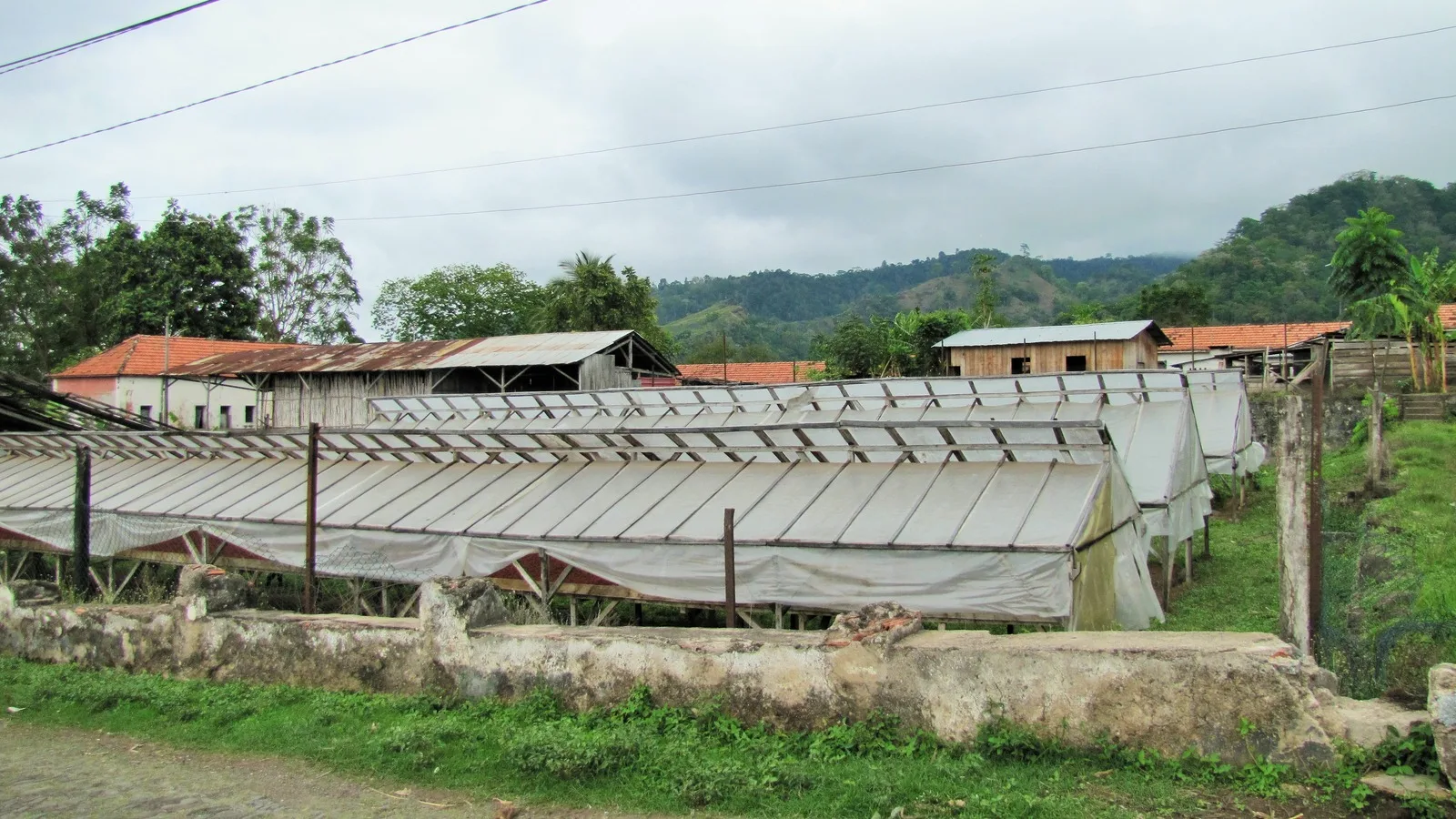
The photograph at the top of this page is a roça, though not one of the six: the sliding-roof shelters are where cocoa was dried, and they are still in use.
Food
Fish, obviously, and very good. Calulu here is fish with greens, aubergine and okra, cousin to the Angolan dish of the same name. Breadfruit and jackfruit grow everywhere. The cocoa is worth taking seriously as something to eat rather than as a souvenir, given what the plantations were built to produce.
Practical orientation
Portuguese is the official language and Forro is widely spoken. The currency is the dobra. There is one international airport, on São Tomé, and Príncipe is reached by a short flight.
The US advisory of 8 October 2025 places the country at Level 2 for one reason only: health. That makes it the mildest advisory of any country in this batch. It says medical services are limited, that there are no adequate trauma or ambulance services, and that even minor health issues may require medical evacuation at the traveler’s expense. On two small islands a long way offshore, that is the planning constraint, and it is an argument for travel insurance rather than against the trip.
Entry requirements vary by nationality and change. This page is not the authority on them.
This page states no entry, health or security requirements, and is not advice. Check your own government’s current guidance before making any decision.
Sources and references
- UNESCO World Heritage Centre: Sao Tome and Principe, States Parties
- UNESCO World Heritage Centre: The Roças of Sao Tome and Principe
- UNESCO Intangible Cultural Heritage: Tchiloli
- US Department of State: Sao Tome and Principe Travel Advisory
These are the authoritative references for the heritage this page discusses; each was checked at source on 13 August 2026. Practical details (entry rules, health guidance, opening times) change constantly. The bodies listed here are authoritative and this page is not.