Heritage
Ancient Thebes: Visitor and Heritage Guide
The capital of Egypt at its height, split across a river: temples for the living on the east bank, tombs for the dead on the west.
- Country Egypt
- Category Heritage
- Reviewed 16 August 2026
- Sources 3
- Length 2 min read
Credit Unsplash
Modern Luxor sits on top of the greatest concentration of monumental architecture anywhere in the world. The city underneath it was Thebes, and for long stretches of Egyptian history it was the capital.
What UNESCO inscribed
Ancient Thebes with its Necropolis was inscribed in 1979. UNESCO describes Thebes as the city of the god Amon and the capital of Egypt during the Middle and New Kingdoms, and names the temples and palaces at Karnak and Luxor and the necropolises of the Valley of the Kings and the Valley of the Queens as striking testimony to Egyptian civilization at its height.
The inscription therefore covers both banks. That is the organizing idea of the whole site and the most useful thing to understand before arriving.
The east bank: temples
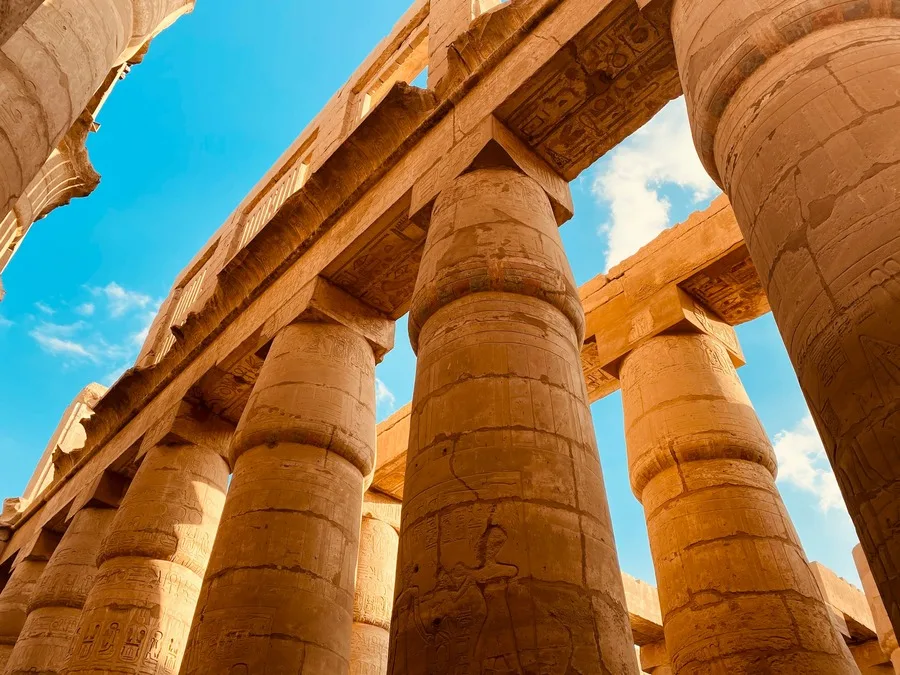
Karnak is not a temple but a complex built and rebuilt over roughly two thousand years by successive rulers, each adding rather than replacing. The hypostyle hall, a forest of massive carved columns, is the single most photographed interior in Egypt and still tends to silence people.
Luxor Temple stands in the middle of the modern town and is connected to Karnak by an avenue of sphinxes that has been excavated along its length. It is the better evening visit, lit after dark.
The west bank: tombs
The dead went to the other side of the river. The Valley of the Kings holds the rock cut tombs of the New Kingdom pharaohs, decorated with funerary texts and, in the best of them, paint that has held its color for three thousand years.
Nearby are the Valley of the Queens, the mortuary temple of Hatshepsut rising in terraces against the cliff, the Colossi of Memnon, and Deir el-Medina, the village of the workers who cut the tombs. That last one is the most human site in Thebes and the most often skipped.
Practical notes
Which tombs are open rotates for conservation, and ticketing changes. The antiquities ministry publishes the current position.
- Start at dawn on the west bank, because the valleys hold heat and have no shade
- A standard ticket admits you to a limited number of tombs, with the famous ones charged separately
- Photography rules inside tombs vary by tomb and are enforced
- Deir el-Medina is quiet, and it is where the people who built the tombs lived
- Two full days is the minimum for both banks, and three is better
- A qualified Egyptologist guide changes this site more than any other in Egypt