Heritage
Cradle of Humankind: Visitor and Heritage Guide
The caves northwest of Johannesburg where the fossil record of our own origins is densest, inscribed by UNESCO as the Fossil Hominid Sites of South Africa.
- Country South Africa
- Category Heritage
- Reviewed 16 August 2026
- Sources 3
- Length 2 min read
Credit Mike Peel, CC BY-SA 4.0, via Wikimedia Commons
An hour northwest of Johannesburg, a belt of dolomitic limestone has been quietly holding the evidence of where we came from. It is known to visitors as the Cradle of Humankind. That is not the name UNESCO inscribed it under, and the difference is worth a paragraph.
The name, and the inscription
The World Heritage property is the Fossil Hominid Sites of South Africa, inscribed in 1999 and extended in 2005. It is a serial listing, which means several separate places held under one inscription: Sterkfontein, Swartkrans, Kromdraai and their environs, the Makapan Valley, and the Taung Skull Fossil Site.
"Cradle of Humankind" is the visitor name for the Gauteng part of it, and it is also UNESCO’s own phrase: the inscription text states that the fossil evidence proves conclusively that the African continent is the undisputed Cradle of Humankind. So the popular name is not a marketing invention. It is simply not the name of the property.
What was found
The Taung Skull was found in a limestone quarry in 1924 and identified as Australopithecus africanus, which was the first evidence that our origins lay in Africa and was disbelieved for two decades because of it.
The caves of the Makapan Valley have yielded traces of occupation going back some 3.3 million years. Specimens of Paranthropus from the sites date between 4.5 and 2.5 million years ago, and there is evidence of the domestication of fire between 1.8 million and 1 million years ago. Taken together UNESCO describes the sites as producing abundant scientific information on human evolution over at least the past 3.5 million years.
UNESCO World Heritage Centre, inscription 915The fossil evidence contained within these sites proves conclusively that the African continent is the undisputed Cradle of Humankind.
Visiting
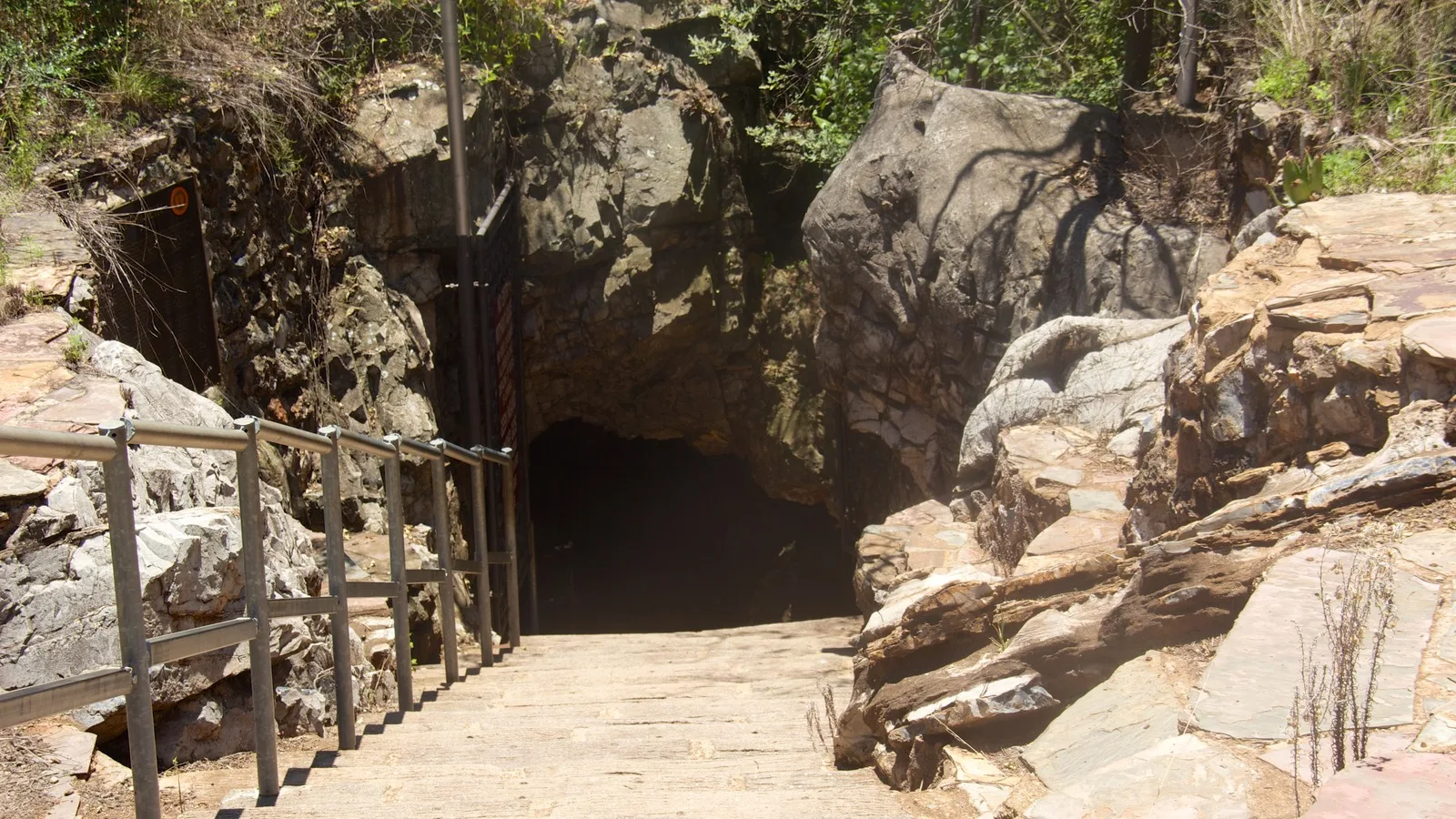
Two things are open to visitors in the Gauteng cluster: the Sterkfontein caves, where the excavation itself can be walked through underground, and a purpose built visitor center that presents the science above ground. They are a short drive apart and are usually done together as a day trip from Johannesburg or Pretoria.
The cave tour involves stairs, uneven footing, low headroom and enclosed spaces, and it is not suitable for everybody. The above ground exhibition is the alternative rather than the consolation. Excavation is still active, which is part of the appeal: this is a working site rather than a finished story.
Practical notes
- Shoes with grip, because the cave route is wet in places and uneven throughout
- The underground section is enclosed and involves stairs and low headroom
- It is comfortably a day trip from Johannesburg or Pretoria, and needs a car
- Check what is open before you drive out, because parts close for conservation work
- The Taung and Makapan components of the inscription are far away and are not part of this visit