Events and Festivals
Ethiopia Festivals and Celebrations
Ethiopia has seven festivals and traditions on UNESCO's intangible heritage list, more than any other country in this series, with fixed dates.
- Country Ethiopia
- Category Events and Festivals
- Reviewed 20 August 2026
- Sources 5
- Length 3 min read
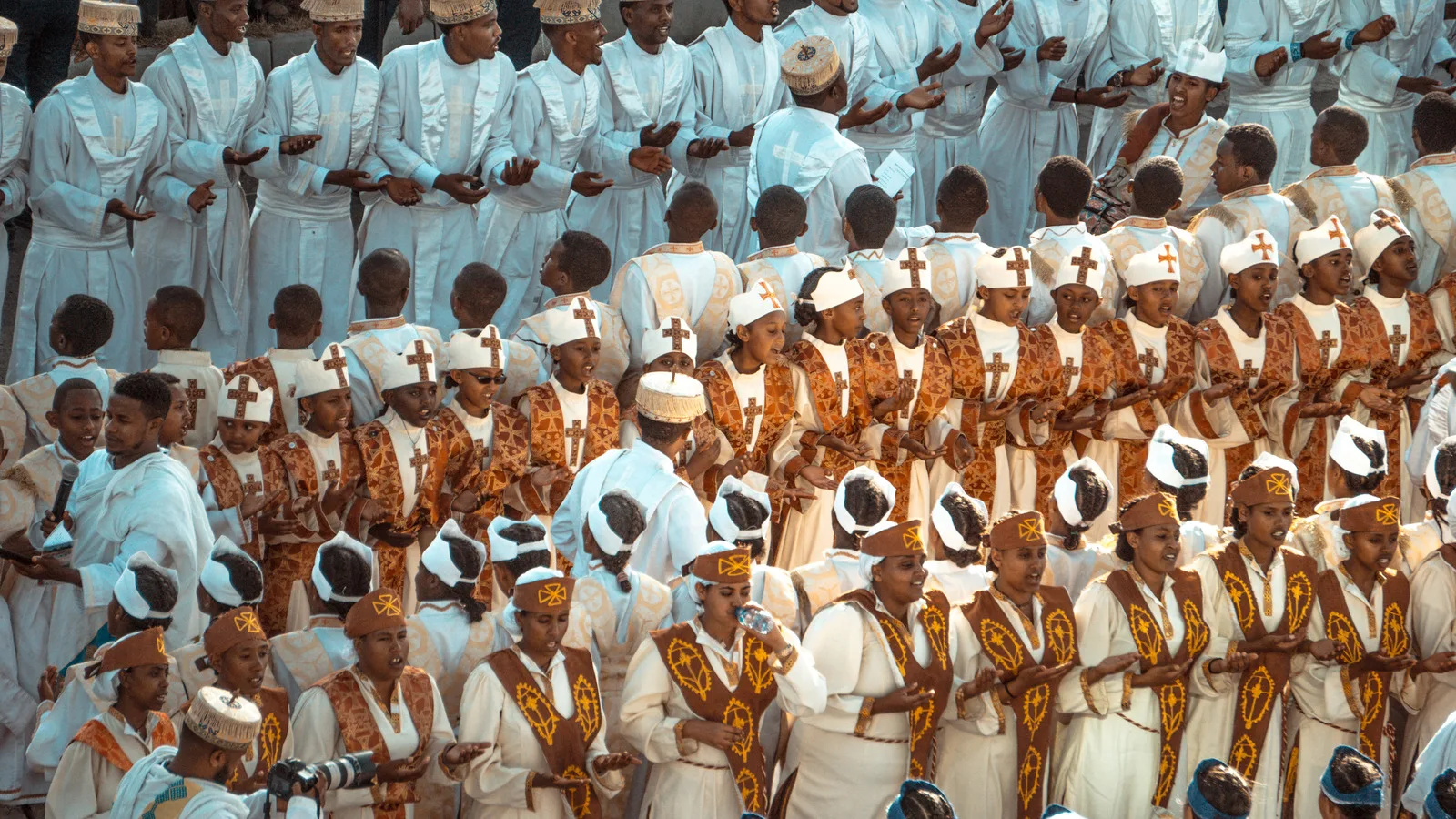
Credit Yonas.aster, CC BY-SA 4.0, via Wikimedia Commons
Seven Ethiopian elements sit on UNESCO's Representative List of the Intangible Cultural Heritage of Humanity. That is more than any other country covered in this series, and the list is unusual in another way too: it spans Christian, Muslim and indigenous traditions from four different peoples, which is a fair description of the country itself.
Timkat, in January
Ethiopian epiphany, inscribed in 2019, commemorates the baptism of Christ by John the Baptist in the River Jordan. UNESCO records that the commemoration begins on the eve of the main festival on 18 January. That eve is called Ketera, a word meaning the blocking of the flow of water for the blessing of the celebrants.
On the eve, parishes escort their tabot, a replica of the Ark of the Covenant, from the church to a pool, river or reservoir known as the Timkete-Bahir, carried by a priest and accompanied by great ceremony, and the night is spent in prayer. It is the largest Christian festival in the Ethiopian year.
Meskel, in September
The commemoration feast of the finding of the True Holy Cross of Christ, inscribed in 2013, is celebrated across the country on 26 September. UNESCO describes the building of the Damera, a conical pyre of poles surrounded by bundles of branches and torches, decorated with green grass and Abyssinian daisies for the New Year, raised in Meskel Square in Addis Ababa.
Hundreds of thousands of people gather as priests in bright vestments chant and perform a rhythmic dance before the pyre, and the patriarch of the Ethiopian Orthodox Church presides at the climax.
One practical note, and we would rather state it than leave it out. Meskel Square is among five areas of Addis Ababa where the FCDO records an increase in reported crime against both foreign and Ethiopian nationals. That is a statement about the neighborhood, not about the festival, and it is worth knowing by anyone planning to be there among a crowd of that size.
Shuwalid, in Harar
Inscribed in 2023, Shuwalid is a three day festival of the Harari people marking the end of six days of fasting that compensate for omissions during Ramadan. UNESCO records that it is celebrated at the shrines of Aw Shulum Ahmed and Aw Akebara, which stand at the main entrance gates of the walled city of Harar.
It opens with supplications and spiritual songs, moves through readings of scripture, music and dance, and closes with words of blessing, and UNESCO notes that it brings together community members of all ages and genders and gives elders a platform to pass on what they know. Of everything in this cluster, it is the festival most readily reachable, because Harar sits in the one region carrying no travel restriction.
The rest of the list
Three separate New Year festivals appear on that list, kept by three different peoples. It is a good reminder that Ethiopia is not one culture with regional variations.
- Gada system of the Oromo, an indigenous democratic system of governance, inscribed 2016.
- Fichee-Chambalaalla, the New Year festival of the Sidama people, inscribed 2015.
- Xeer Ciise, the oral customary laws of Somali-Issa communities in Ethiopia, Djibouti and Somalia, inscribed 2024.
- Gifaataa, the New Year festival of the Wolaita people, inscribed 2025 and the most recent Ethiopian addition.
Before you plan around one
Festivals draw very large crowds, and the FCDO states that a terrorist attack in Ethiopia could occur at any time, including at religious events and public holidays. It also records temporary closures of roads, internet and mobile networks.
None of that is a reason not to go to a festival in an unrestricted region. It is a reason to arrive with a plan that does not depend on a working phone, and to agree a meeting point with anyone you are traveling with.
Sources
- UNESCO: intangible cultural heritage in Ethiopia
- UNESCO: Ethiopian epiphany, inscribed 2019
- UNESCO: commemoration feast of the finding of the True Holy Cross, inscribed 2013
- UNESCO: Shuwalid festival, inscribed 2023
- UK FCDO: Ethiopia safety and security
All seven inscriptions and their dates read from UNESCO on 20 August 2026, from the Ethiopian state page and from the individual element pages for Ethiopian epiphany, the True Holy Cross, Shuwalid and the Gada system. Security context read from the UK FCDO safety and security page the same day. We publish no movable dates, because the fixed ones are the ones UNESCO states.