Heritage
Kairouan: Visitor and Heritage Guide
Founded in 670 AD, the oldest Arabo-Muslim base in the Maghreb and capital of Ifriqiya for five centuries. Its Great Mosque became the model.
- Country Tunisia
- Category Heritage
- Reviewed 20 August 2026
- Sources 4
- Length 2 min read
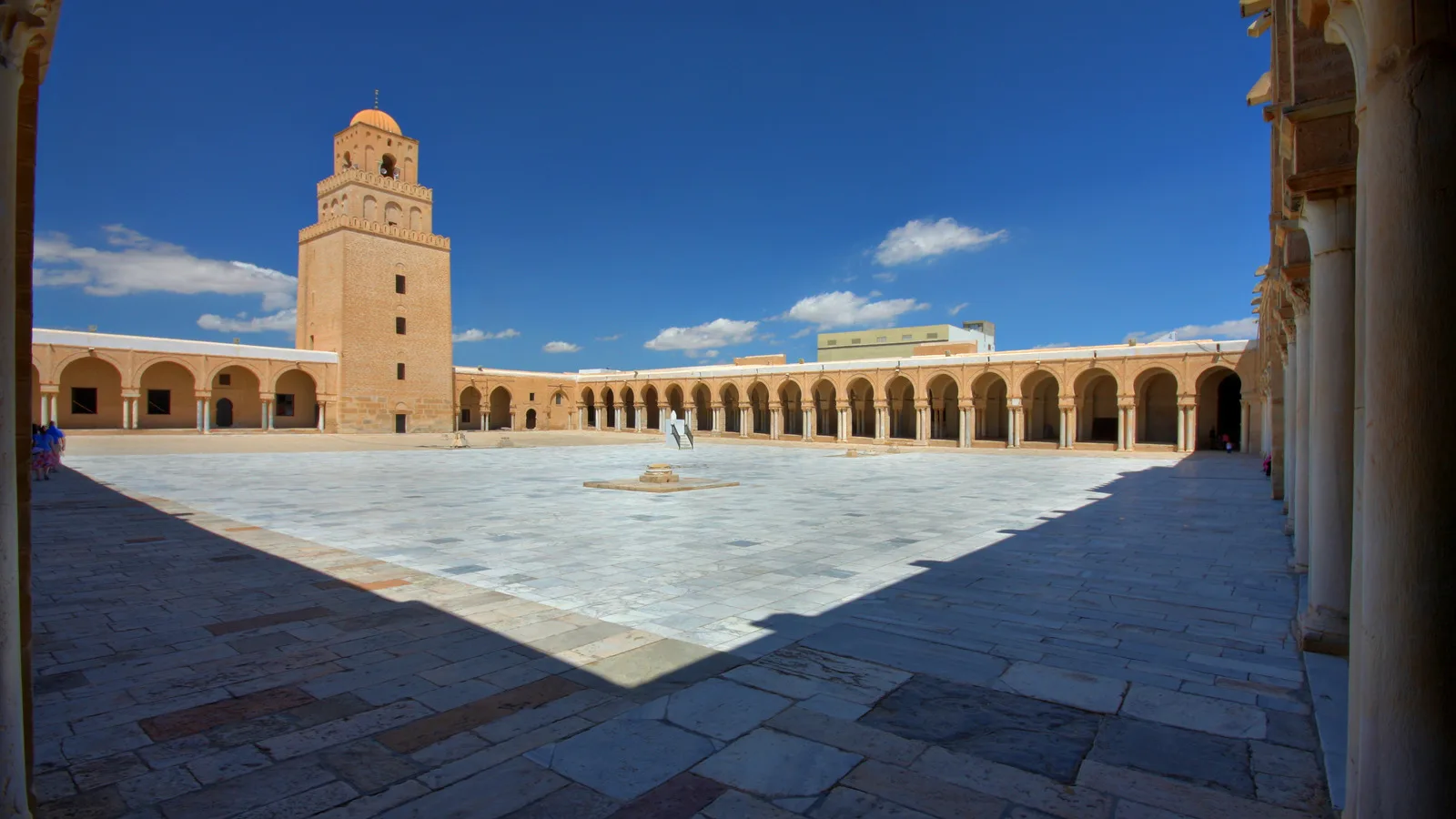
Credit Andrew Watson, CC BY-SA 2.0, via Wikimedia Commons
Kairouan sits on a plain in the middle of Tunisia at roughly equal distance from the sea and the mountains, which is a strange place to put a city until you understand that it was founded as a garrison. It was inscribed in 1988, and UNESCO calls it the most ancient Arabo-Muslim base of the Maghreb and one of its principal holy cities.
670 AD, and five centuries as a capital
Kairouan was founded in 670 AD and was the capital of Ifriqiya for five centuries. UNESCO describes it as a place of outstanding diffusion of Arabo-Muslim civilization, bearing unique witness to the first centuries of that civilization and to its architectural and urban development. For anyone reading North and West African history, that is the point: this is where the architectural vocabulary of Maghrebi Islam was worked out before it traveled.
The inscribed property is serial. It takes in the medina of 54 hectares and its suburbs of 20, and separately the Basins of the Aghlabids and the Zawiya of Sidi Sahib. The medina's ramparts run for more than three kilometers.
The Great Mosque, and the three other things
The Great Mosque was rebuilt in the ninth century and UNESCO describes it as not only one of the major monuments of Islam but a universal architectural masterpiece, and as the model for several other Maghrebi mosques. The prayer hall forms a quadrilateral of 135 meters by 80. At its southern end is a hypostyle hall of seventeen naves supported by what the inscription calls a forest of columns in marble and porphyry. The courtyard is flagstoned and bordered with porticoes, and the massive square minaret of three stories interrupts the northern end.
Three other things are worth the walk. The Mosque of the Three Doors carries what UNESCO records as the most ancient surviving sculpted facade in Muslim art. The Basins of the Aghlabids are a ninth century open air reservoir of two communicating cisterns, one of the most beautiful hydraulic ensembles built to water a town. And the Zawiya of Sidi Sahib holds the remains of Abou Zama El-Balawi, a companion of the Prophet.
Visiting
Photography inside religious buildings should be asked about rather than assumed.
- Kairouan is a working holy city, not a monument. Dress accordingly and expect prayer to take precedence over visiting hours.
- Non-Muslims may enter the courtyard of the Great Mosque at set hours but not the prayer hall.
- Cover shoulders and knees. This matters more here than anywhere else in Tunisia.
- The Aghlabid basins are a short distance outside the medina walls and are easy to miss.
- It is about three hours from Tunis and is often done as a long day trip. It deserves a night.
- The city is known for its carpets, and the workshops are genuine.
Sources and references
- UNESCO World Heritage Centre: Kairouan
- UNESCO World Heritage Centre: Tunisia, States Parties
- Tunisian National Tourist Office
- UK FCDO: Tunisia travel advice
The foundation date, the serial components, the mosque dimensions and the seventeen naves are all from the property's UNESCO page, read at source on 19 August 2026.