Tunisia
Carthage is the one everybody knows, and it is one of ten
- Region North Africa
- Country Tunisia
- Type Country
- Reviewed 11 August 2026
- Sources 4
- Length 4 min read
Credit HikerPort, Unsplash
Why Tunisia
Tunisia is the smallest country in North Africa and it is sold, overwhelmingly, as a stretch of Mediterranean coast with a hotel on it. UNESCO lists ten properties here and classes nine of them as cultural.
They run from a Phoenician capital to a Roman amphitheater in a farming town, from the medinas of Tunis and Sousse to a Punic town abandoned early enough that nobody built over it, and out to an island inscribed not for a monument but for the shape of its settlement. Very little of that is within sight of a sun lounger.
Carthage
Carthage sits on a hill above the Gulf of Tunis. Founded from Tyre at the end of the ninth century BC, it became the metropolis of Punic civilization in Africa and, after Rome had destroyed it and rebuilt it on its own ruins by order of Julius Caesar, the capital of the province of Africa, and later of a Vandal kingdom and of the Byzantine province.
What survives is layered accordingly: the acropolis of Byrsa, the Punic ports, the tophet with its stelae, a theater, an amphitheater, a circus, the Antonine baths. UNESCO reads the ports as evidence of exchange across more than ten centuries, and the site as a place where Phoenician, Punic, Roman, Paleochristian and Arab presence followed one another rather than replacing one another cleanly.
El Jem, and an island
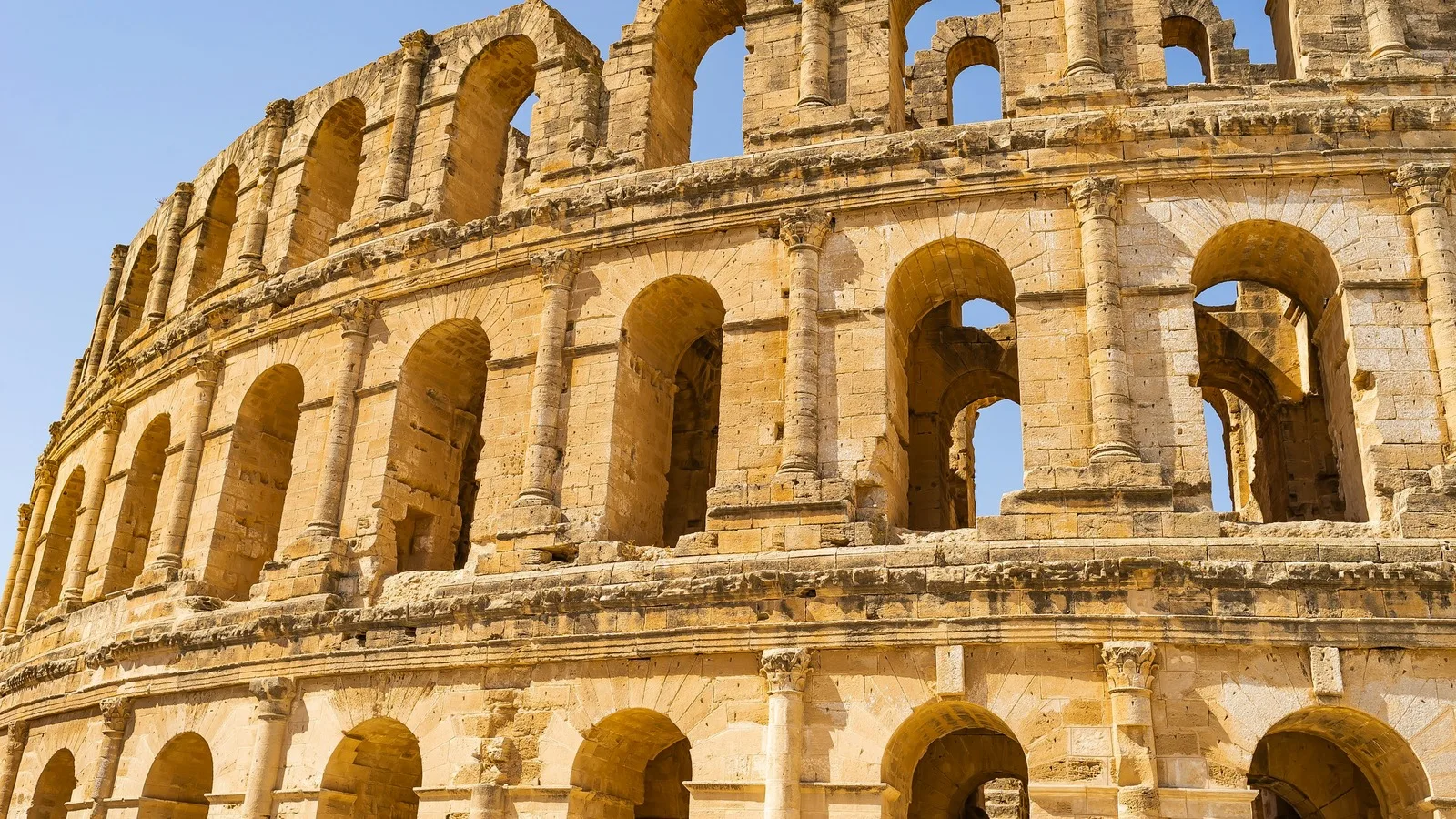
El Jem is a small town on a plain in central Tunisia with a Roman amphitheater in the middle of it. Built around 238 AD entirely of stone blocks, with no foundations, it stands free rather than leaning on a hillside as most provincial amphitheaters do. Its axes measure 148 meters by 122, its capacity is judged at 35,000, its facade carries three levels of arcades, and the podium wall, the arena and the underground passages are practically intact. The scale of the thing against the size of the town is the point: a sophisticated building for popular spectacle, put up in a far-off province, is imperial propaganda in stone.
Off the south east coast, Djerba was inscribed for something quite different, which is the subject of the note below.
Food
Tunisian cooking is the spiciest in the Maghreb, and harissa is the reason. It arrives with bread and olive oil before anything is ordered. Brik is a paper-thin pastry folded around egg and tuna and fried so that the yolk is still liquid, which is a problem you solve standing up. Couscous here is often made with fish rather than lamb, and lablabi, a chickpea soup poured over torn bread with cumin, harissa and a soft egg, is breakfast.
Practical orientation
Arabic is the official language and Tunisian Arabic is what you will hear; French is widely used in business and signage. The currency is the dinar and it cannot be taken out of the country. The country is compact enough that Tunis, Carthage, El Jem and Kairouan sit inside a short itinerary.
Entry requirements and health guidance vary by nationality and change. The Ministry of Foreign Affairs, Migration and Tunisians Abroad is the authority on them, and this page is not.
Sources and references
- UNESCO World Heritage Centre: Archaeological Site of Carthage
- UNESCO World Heritage Centre: Amphitheatre of El Jem
- UNESCO World Heritage Centre: Djerba, Testimony to a settlement pattern in an island territory
- Ministry of Foreign Affairs, Migration and Tunisians Abroad, Republic of Tunisia
These are the authoritative references for the heritage this page discusses; each was checked at source on 11 August 2026. Practical details (entry rules, health guidance, opening times) change constantly. The bodies listed here are authoritative and this page is not.