Heritage
Kibiro Salt Village: Visitor and Heritage Guide
Nine hundred years of salt made on the shore of Lake Albert, in gardens owned and worked entirely by women, under a rift escarpment.
- Country Uganda
- Category Heritage
- Reviewed 18 August 2026
- Sources 2
- Length 3 min read
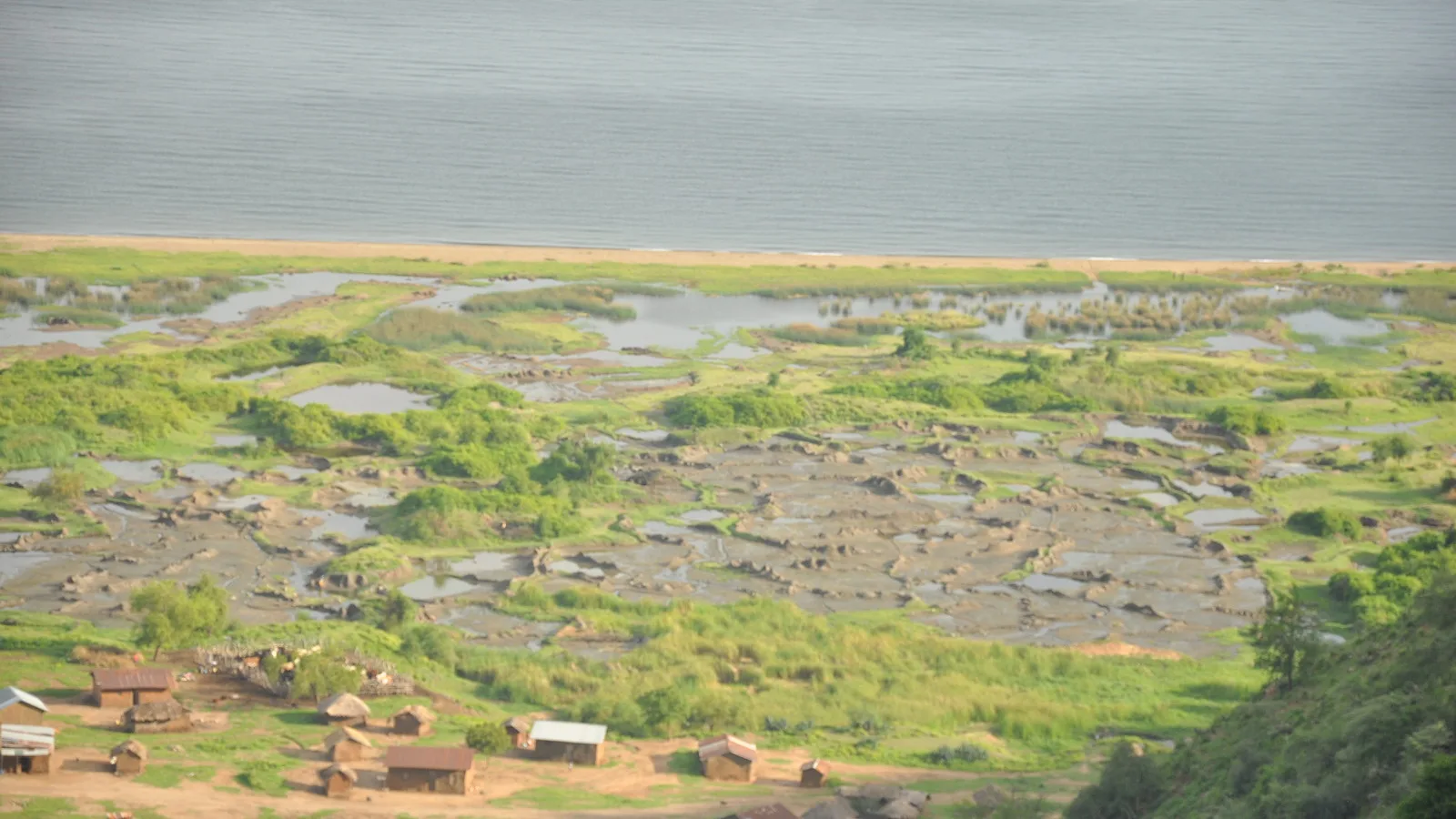
Credit NUWAHWERA PHIONAH, CC BY-SA 4.0, via Wikimedia Commons
Kibiro has been making salt for about nine hundred years, and the gardens it is made in pass from mother to daughter. Both halves of that sentence are unusual, and the second is the reason the village is on Uganda's Tentative List.
Where it is
Kibiro sits roughly 200 kilometers west of Kampala, in Kigorobya Sub-County, Hoima District, within the territory of the Bunyoro-Kitara Kingdom, one of the oldest kingdoms in the region and today one of Uganda's constituent kingdoms.
It is wedged between Lake Albert and an escarpment 300 to 600 meters high on the eastern side of the Western Rift Valley. Getting down to it means walking down that escarpment, which is the single fact that most affects a visit.
The property is about 10 hectares and includes the salt gardens, a hot spring, ritual sites and archaeological ground.
How the salt is made
The technique is a form of ash salt production and it is a closed loop. Residual earth is recycled with fresh soil and spread across the salt gardens, where saline water rises into it through capillary action. The soil is scraped, spread and heaped over roughly a week, then leached and boiled until the salt crystallises.
There are four salt garden areas. Munteri is the largest, then Kantanda; Nyanchibo is partly submerged in Lake Albert and its date is uncertain; Muchanga is associated with the hot spring. Three of the four are still worked.
Archaeologists have found potsherds across the village to a depth of four meters, dating back eight to nine hundred years, from the pottery used in the leaching and boiling. Salt from Kibiro underwrote the economy of the Bunyoro-Kitara Kingdom.
Owned by women, worked by women
Salt processing at Kibiro is carried out exclusively by women, and ownership of the salt gardens descends through the female line: mother to daughter, to an aunt, or to a daughter-in-law. UNESCO's Tentative List submission makes this the center of its case, noting that it is not how the other salt-producing sites it compares Kibiro with are organized.
Uganda submitted the nomination in 2025. It is a Tentative List entry, which means it is proposed rather than inscribed, and the process is long.
Visiting
Kibiro is a working village and not set up for volume. The descent from the escarpment is steep and takes a good hour on foot in each direction, and there is no road down.
Arrange the visit through the district or a local guide rather than arriving unannounced, ask before photographing anyone at work, and buy salt. It is the product of the place and the money goes to the woman who made it.
If you go
- Arrange it through a local guide rather than arriving unannounced
- Allow a full day; the escarpment walk is about an hour each way
- Boots, water and sun protection; there is no shade on the descent
- Ask before photographing anyone working
- Buy salt from the producer
Sources and references
The location, area, technique, garden names, potsherd depths, the matrilineal ownership and the 2025 submission date are from the UNESCO Tentative List entry for Kibiro Salt Producing Village, read at source on 18 August 2026. It is a proposal and not an inscribed World Heritage property.