Uganda
Mountain forest, the Buganda kingdom, and a country greener than the stereotype
- Region East Africa
- Country Uganda
- Type Country
- Reviewed 10 August 2026
- Sources 3
- Length 4 min read
Credit Random Institute, via Unsplash
Why Uganda
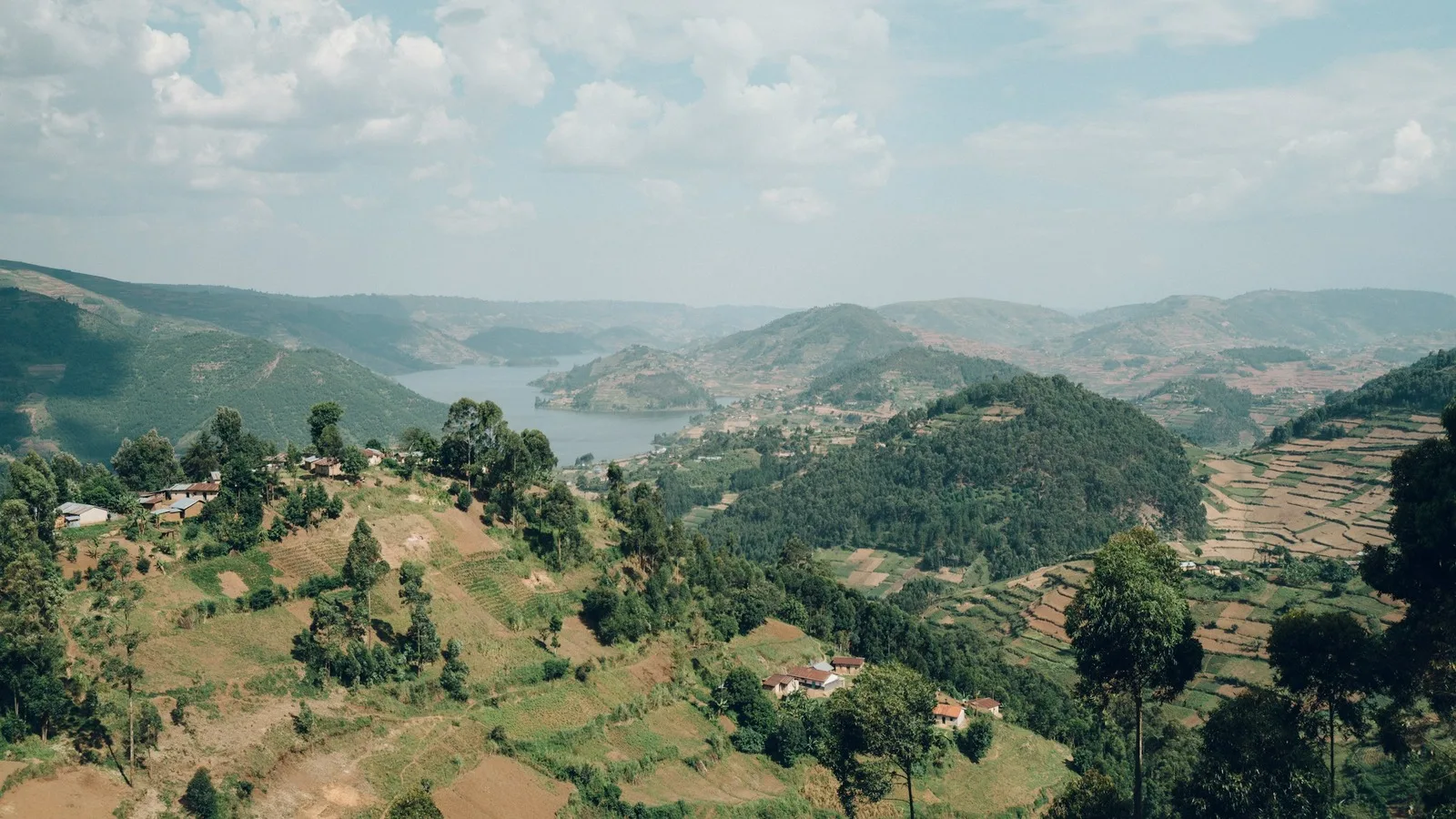
Uganda sits where the East African plains meet the mountain forests of the continent’s interior, and the result is a country far greener and more vertical than the regional stereotype allows. Three of its landscapes are on the World Heritage List: Bwindi, the Rwenzori Mountains, and the royal tombs at Kasubi in Kampala.
Most itineraries here are built around one animal. That is understandable, and it is also a narrow way to see a country whose kingdoms, lakes and mountains would carry a trip on their own.
Bwindi, and what a permit buys
Bwindi Impenetrable National Park covers 32,000 hectares in the south-west, at the junction of plain and mountain forest, and UNESCO records more than 160 species of tree and over 100 species of fern inside it. It is also one of the last homes of the mountain gorilla.
Tracking is by permit, the number issued each day is capped, and the cost is high. That structure is the conservation instrument rather than a pricing accident: a small number of expensive visits, with the revenue making the argument for the forest’s continued existence against every other use the land could be put to.
Kasubi, and the Buganda kingdom
On a hillside in Kampala stand the Tombs of Buganda Kings at Kasubi, a former royal palace built in 1882 and converted into the royal burial ground in 1884, where four kabakas lie within a great circular building surmounted by a dome. It is built of organic material, principally wood, thatch, reed, wattle and daub, and is a major architectural achievement in those terms.
Its significance, though, as UNESCO’s own reasoning puts it, lies mainly in the intangible: belief, spirituality, continuity and identity. It remains the most active religious place in the kingdom, where rituals are frequently performed. A visitor there is a guest at a working site of practice.
Food
Matoke (green banana, steamed and mashed) is the staple of the south, served with groundnut sauce or beans. The rolex, a chapati rolled around fried egg, is the national street food and is as good as its devotees insist. Lake Victoria supplies tilapia and Nile perch, usually grilled whole.
Practical orientation
English and Kiswahili are official; Luganda is very widely spoken in and around Kampala. The currency is the Ugandan shilling. There are two rainy seasons, roughly March to May and September to November. Gorilla tracking runs year-round, though the forest is steep and the ground slippery in the wet.
Entry and health requirements vary by nationality and change. Consult the Uganda Tourism Board and your own government before you travel.
Sources and references
- UNESCO World Heritage Centre: Bwindi Impenetrable National Park
- UNESCO World Heritage Centre: Tombs of Buganda Kings at Kasubi
- Uganda Tourism Board
These are the authoritative references for the World Heritage sites this page discusses; each was checked at source on 10 August 2026. Practical details (entry rules, health guidance, opening times) change constantly. The bodies listed here are authoritative and this page is not.
Travel guides and articles for Uganda
-
Article
Tombs of Buganda Kings at Kasubi: Visitor and Heritage Guide
A royal burial ground of thatch and barkcloth that burned down, was rebuilt over thirteen years, and left the Danger List in 2023.
-
Article
Bwindi Impenetrable National Park: Visitor and Heritage Guide
Almost half the world's mountain gorillas live in one forest surrounded by farmland at 350 people to the square kilometer.
-
Article
Rwenzori Mountains National Park: Visitor and Heritage Guide
Glaciers on the equator, Africa's third highest peak, and an alpine flora that has been called Africa's botanical big game.
-
Article
Nyero Rock Art: Visitor and Heritage Guide
Geometric paintings in three rock shelters in eastern Uganda, whose age and makers are still disputed by the people who list them.
-
Article
Kibiro Salt Village: Visitor and Heritage Guide
Nine hundred years of salt made on the shore of Lake Albert, in gardens owned and worked entirely by women, under a rift escarpment.
-
Article
Best Time to Visit Uganda
Two dry windows for tracking, two wet ones for birds and lower prices, and one monthly morning that stops the whole country.
-
Travel planning
Uganda Visa and Entry Requirements
No visa on arrival, a yellow fever certificate that is genuinely compulsory, and one regional visa that covers three countries at once.
-
Travel planning
Uganda Currency and Money Guide
The Ugandan shilling, a mobile money system that runs the country, and another government advisory with no money page at all.
-
Travel planning
Uganda Packing List
One clothing rule in Uganda carries a maximum sentence of life imprisonment, and it applies to children as well as adults.
-
Travel planning
Getting Around Uganda
Boda bodas everywhere, long distances on mixed roads, and one Saturday morning each month when non-essential movement is prohibited nationwide.
-
Travel planning
Uganda Travel Safety Guide
Attacks have reached national parks and tourists, an Ebola outbreak has reached Kampala, and one law carries the death penalty.
-
Article
Uganda Food Guide
A steamed green banana that counts as the national dish, and a chapati wrapped around eggs that counts as the national snack.
-
Article
Uganda Culture and Etiquette Guide
A republic containing kingdoms, a cloth made from bark, and several rules of dress and speech that carry criminal penalties.
-
Article
Uganda Festivals and Celebrations
A calendar of kingdoms, pilgrimage and one of the continent's best known music festivals, currently under public health restrictions.
-
Article
Uganda and Diaspora Reconnection
Uganda is far more significant as a country people arrive in than as one they left, and that changes what a reconnection visit means.
-
Travel planning
Accessible Travel in Uganda
A boat on the Kazinga Channel is among the most rewarding hours in the whole country, and one of the very few that asks nothing at all of your legs.