Heritage
The King's Palace at Nyanza: Visitor and Heritage Guide
A reconstructed royal residence at the old capital of a court that moved, and a herd of cattle whose keepers still sing to them.
- Country Rwanda
- Category Heritage
- Reviewed 18 August 2026
- Sources 3
- Length 3 min read
Credit Hanay, CC BY-SA 3.0, via Wikimedia Commons
Nyanza was the seat of the Rwandan monarchy, and the King's Palace there is a reconstruction of the royal residence: a large thatched dwelling shaped like a beehive, built with the methods of the court that occupied the hill.
Why Nyanza
For a long period the Rwandan monarchy was mobile. The court moved between locations rather than ruling from a fixed capital, which is a different political arrangement from the one most visitors bring with them, and it is the reason the country has no ancient stone capital to visit.
When the court did settle, Nyanza was the choice. Oral tradition holds it as the site of battles and power struggles, and the capital of the kingdom is recorded as having had as many as 2,000 inhabitants, in dwellings built the way the reconstruction is built.
Rwanda ceased to be a monarchy in 1962, at independence. The palace you visit is therefore a reconstruction of an institution that ended within living memory, not a ruin from a remote period.
The Inyambo
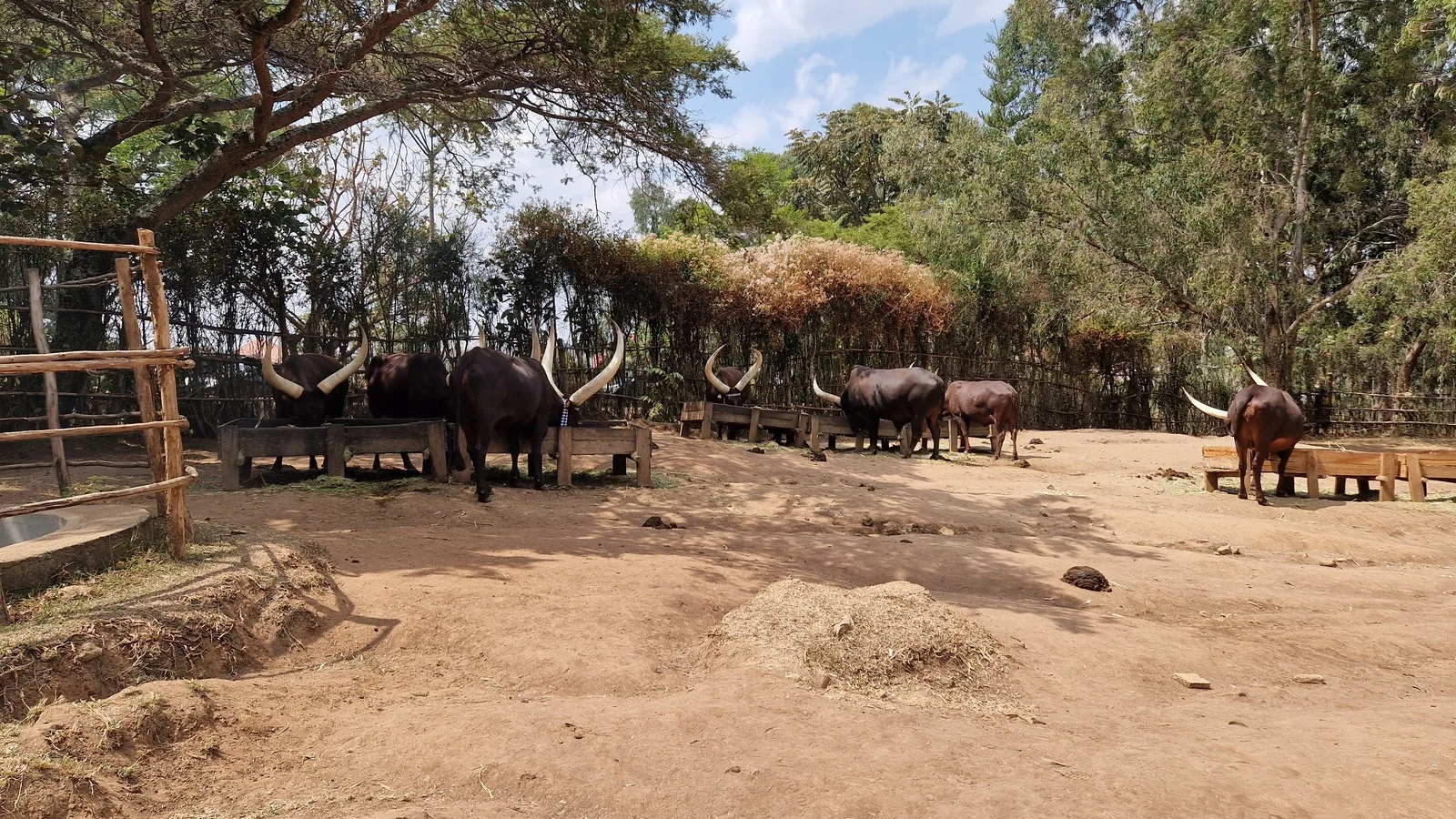
Behind the palace are the Inyambo, long horned cattle descended from the king's herd. They are the reason to come.
They derive from the wider Ankole breed and they had a ceremonial role: decorated with rich jewelry, they were trained to listen to a trainer's songs and to follow his movements in a stately parade at ceremonies honoring the king. Their keepers still tend and sing to them.
Cattle carry a weight in Rwandan culture that is easy for a visitor to underestimate. They were wealth, they were the substance of social obligation between people, and they were the gift that created a relationship. A herd kept for song rather than for milk or meat is not a curiosity laid on for tourists; the breeding and grooming of Inyambo is carried out under the Rwanda Agriculture Board.
What to expect, and what is nearby
This is a small site and a short visit, and it rewards a guide. The building is the obvious subject and the cattle are the memorable one. Ask about the songs.
The Ethnographic Museum in Huye is close by and holds what Visit Rwanda describes as one of Africa's finest ethnographic collections. The two combine naturally into a day, and between them they carry most of what a visitor can see of Rwandan material culture before the twentieth century.
Neither site is on the World Heritage List, and Rwanda has no Tentative List at all, so there is no inscription document to read for either. What exists is the national tourism authority and the museums themselves.
Practical
- Take a guide; the site is small and the interest is in the explanation
- Ask about the songs and the training of the Inyambo
- Combine with the Ethnographic Museum at Huye
- Expect a reconstruction, and an institution that ended in 1962
- Ask before photographing keepers or other visitors
Sources and references
- Visit Rwanda: the King's Palace
- Visit Rwanda: the national tourism site
- UNESCO World Heritage Centre: Rwanda
The account of the palace, the mobile court, the 2,000 inhabitants, the end of the monarchy in 1962 and the ceremonial role of the Inyambo is from Visit Rwanda, the national tourism site, read at source on 18 August 2026. Rwanda has two inscribed World Heritage properties and no Tentative List; neither this site nor the Huye museum is among them.