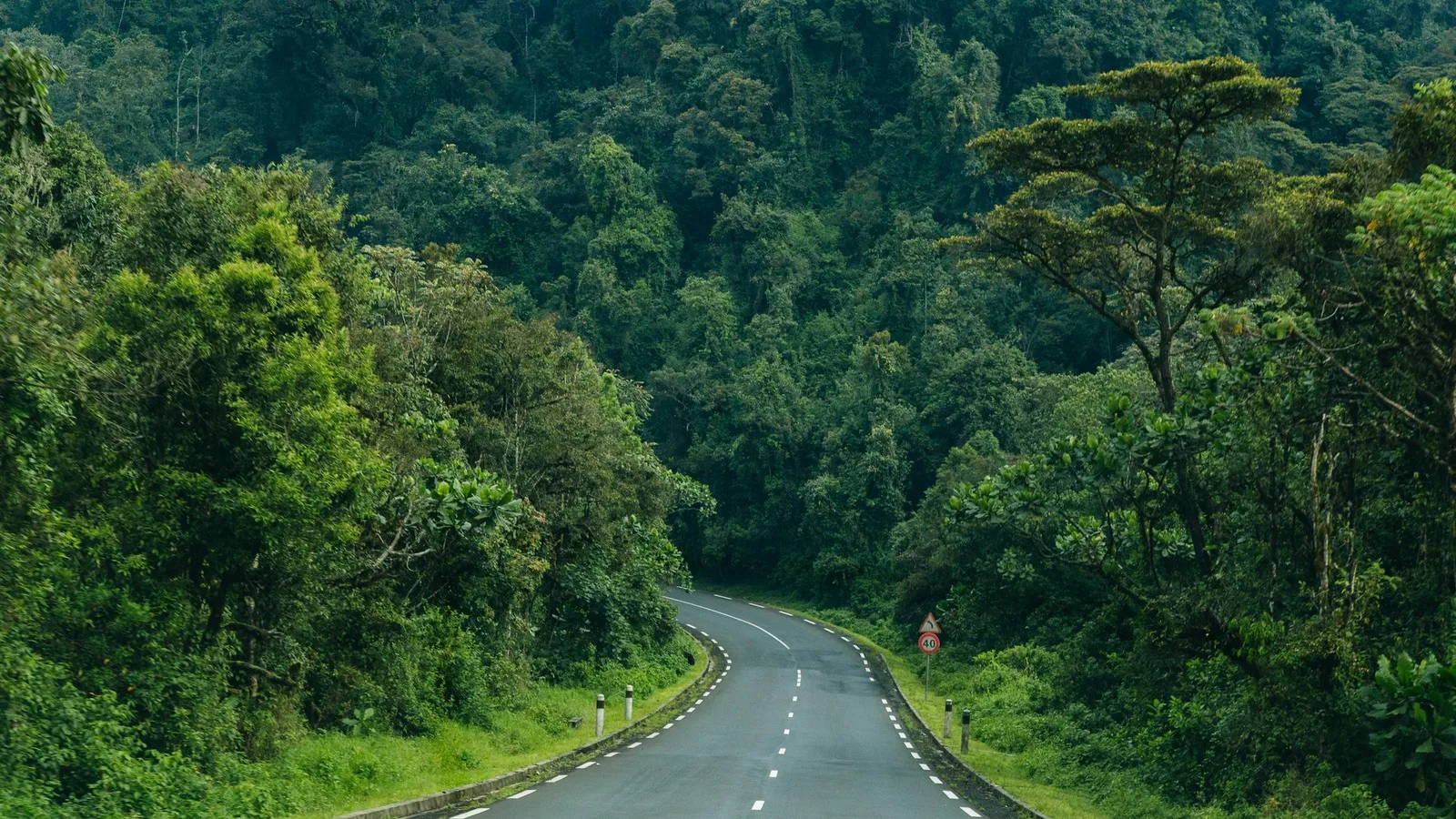
Forest, altitude, and memorial sites now on the World Heritage List
RegionEast Africa
CountryRwanda
TypeCountry
Reviewed10 August 2026
Sources3
Length4 min read
Credit Faustin T, via Unsplash
Why Rwanda
Rwanda is small, high and densely populated, a country of cultivated hills where very nearly every slope is worked, and where the distance between two places is more usefully measured in hours than in kilometers.
It is also a country that has organized a great deal of its public life around memory. A visitor who comes only for the primates will still encounter that. It is better to arrive having thought about it than to meet it unprepared on a Tuesday afternoon.
Forest, altitude and the primates
Nyungwe National Park, on the World Heritage List, is one of the more significant rainforest conservation areas in the region: intact forest together with peat bogs, moors, thickets and grassland, holding habitats for species found nowhere else. It is walked rather than driven, and the tracking there is for chimpanzees and monkeys.
The mountain gorillas are further north, in the volcanoes along the Congolese and Ugandan borders. Permits are limited in number and expensive by design: the price is the instrument that keeps daily visitor numbers low.
Kigali as a working city
Kigali is spread over several hills and is unusually orderly by regional standards: clean, well lit, and comfortable to walk at night, which visitors remark on so consistently that the remark has become its own cliché. It is a working capital with a conference economy, a good restaurant scene, and a self-presentation that is carefully managed.
The orderliness is policy, and like all policy it is argued about, inside the country as well as outside it. It is worth knowing that the calm a visitor experiences is produced rather than natural, without letting that observation curdle into cynicism about a city that plainly works.
Food
Everyday eating is starch-led and generous: beans, plantain, cassava, sweet potato and rice, often served as a buffet where you take one plate and fill it once. Brochettes (grilled skewers, usually goat) are the standard evening food, and the milk bars serving ikivuguto, a fermented milk, are a local institution rather than a visitor attraction.
Practical orientation
Kinyarwanda is the national language; English, French and Kiswahili are also official, and English is the language of schooling. The currency is the Rwandan franc. There are two rainy seasons, roughly March to May and October to November, and the drier stretches are the standard tracking months.
Entry and health requirements vary by nationality and change. Consult the Rwanda Development Board and your own government before you travel.
These are the authoritative references for the World Heritage sites this page discusses; each was checked at source on 10 August 2026. Practical details (entry rules, health guidance, opening times) change constantly. The bodies listed here are authoritative and this page is not.