Events and Festivals
Malawi Festivals and Celebrations
Six traditions on the UNESCO lists and one lakeside music festival. Malawi keeps its calendar in dance rather than in dates you can book.
- Country Malawi
- Category Events and Festivals
- Reviewed 19 August 2026
- Sources 4
- Length 2 min read
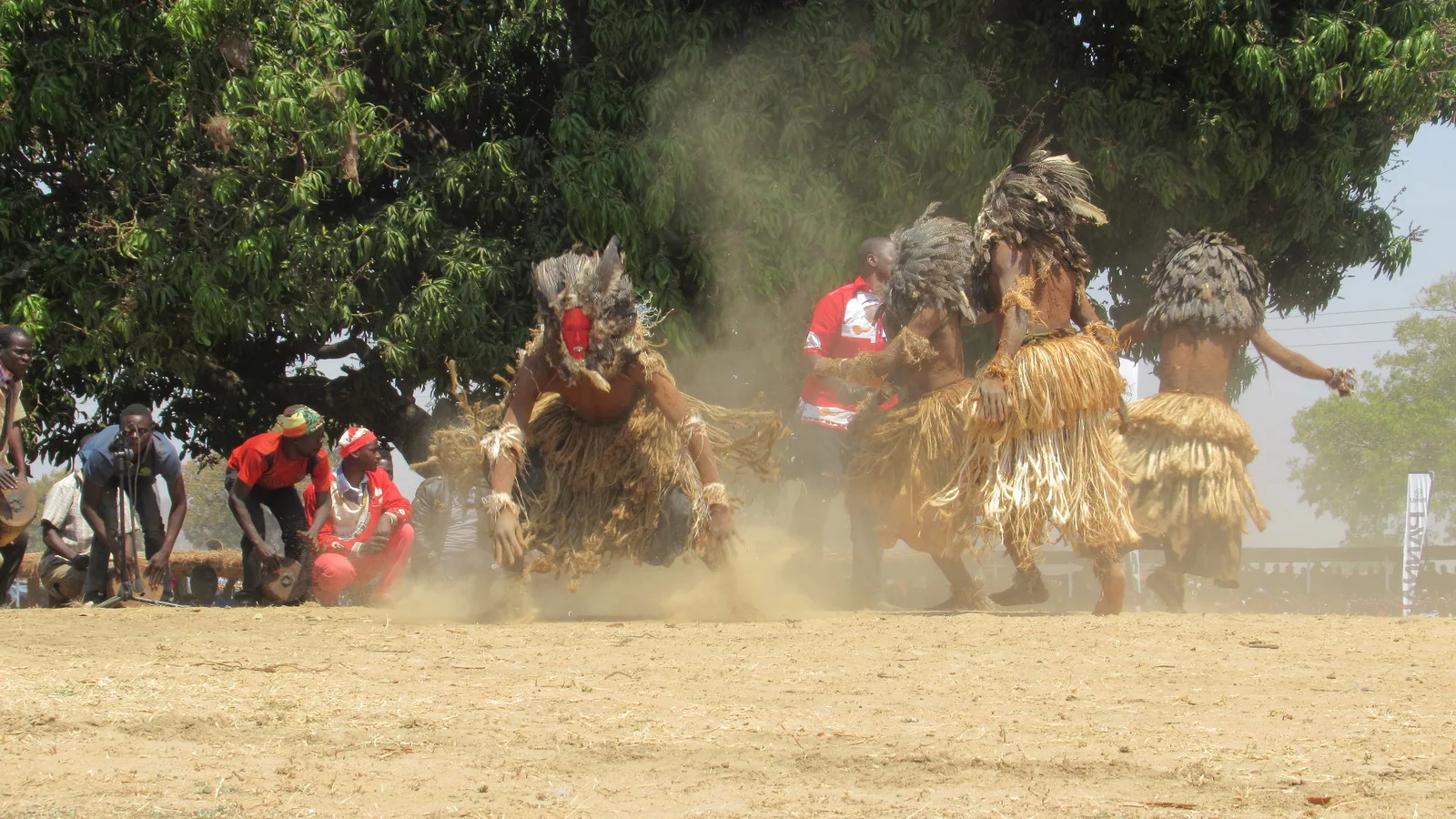
Credit SebastiaanMatla, CC BY-SA 4.0, via Wikimedia Commons
Malawi has six elements inscribed on the UNESCO Representative List of the Intangible Cultural Heritage of Humanity, which is a striking number for a country of its size and a larger number than Tanzania, which has none at all. What it does not have is a festival calendar a visitor can plan around. Most of what is inscribed here happens when it happens, in a village, for a reason that has nothing to do with tourism.
Gule Wamkulu
The Great Dance, performed by masked members of the Nyau brotherhood among the Chewa, was inscribed in 2008. It is danced at the end of male initiation, at funerals and at the installation of a chief. The masks are characters, each with its own drumbeat and its own song, and the dancers respond to the drum rather than lead it.
It is inscribed for Malawi, Mozambique and Zambia together, because the Chewa are one people across three colonial borders. If you are shown Gule Wamkulu, you are being shown something that is still doing its original work.
Vimbuza, Tchopa and Mwinoghe
Vimbuza, inscribed in 2008, is a healing dance of the Tumbuka in the north. A patient dances to drums inside a temple house while the community sings, and the dance is the treatment rather than an accompaniment to it. Tchopa, inscribed in 2014, is a sacrificial dance of the Lhomwe of the south, performed after a good harvest, in drought and at funerals. Mwinoghe, the joyous dance, was inscribed in 2018 and comes from the far north.
The sixth is the art of crafting and playing the mbira, or sansi, the finger plucked instrument inscribed in 2020 jointly with Zimbabwe. The fifth, and the one most visitors meet first, is nsima, inscribed in 2017: a culinary tradition rather than a performance.
Where a visitor might actually see something
- Around Dedza and the Chongoni hills, where the Nyau are strongest.
- In the northern districts for Vimbuza, which is performed at night.
- At the Lake of Stars music festival on the lakeshore, when it runs.
- At Independence Day on 6 July and Kamuzu Day on 14 May.
- At Mother's Day in October and at any village funeral or chief's installation you are invited to.
- Ask a lodge rather than a website. Nothing here is scheduled the way a visitor expects.
Being present without being a problem
These are ceremonies, not performances. Ask before photographing, and expect the answer sometimes to be no, particularly with Nyau, where the masked dancer is not a person in a costume and photographing him may be refused for reasons that are not about privacy. Do not pay to have a ceremony staged. If you are invited, go, and follow whoever invited you.
Sources and references
- UNESCO: Malawi on the intangible cultural heritage lists
- UNESCO: Gule Wamkulu, inscribed for Malawi, Mozambique and Zambia
- UNESCO: Vimbuza healing dance
- Malawi: the destination guide
Every inscription year above was read from the UNESCO intangible cultural heritage lists for Malawi. Gule Wamkulu's multinational status is recorded on its own element page.