Heritage
Nyungwe National Park: Visitor and Heritage Guide
One of Africa's great montane rainforests, protected since 1933, with a lit international highway running through the middle of it.
- Country Rwanda
- Category Heritage
- Reviewed 18 August 2026
- Sources 4
- Length 3 min read
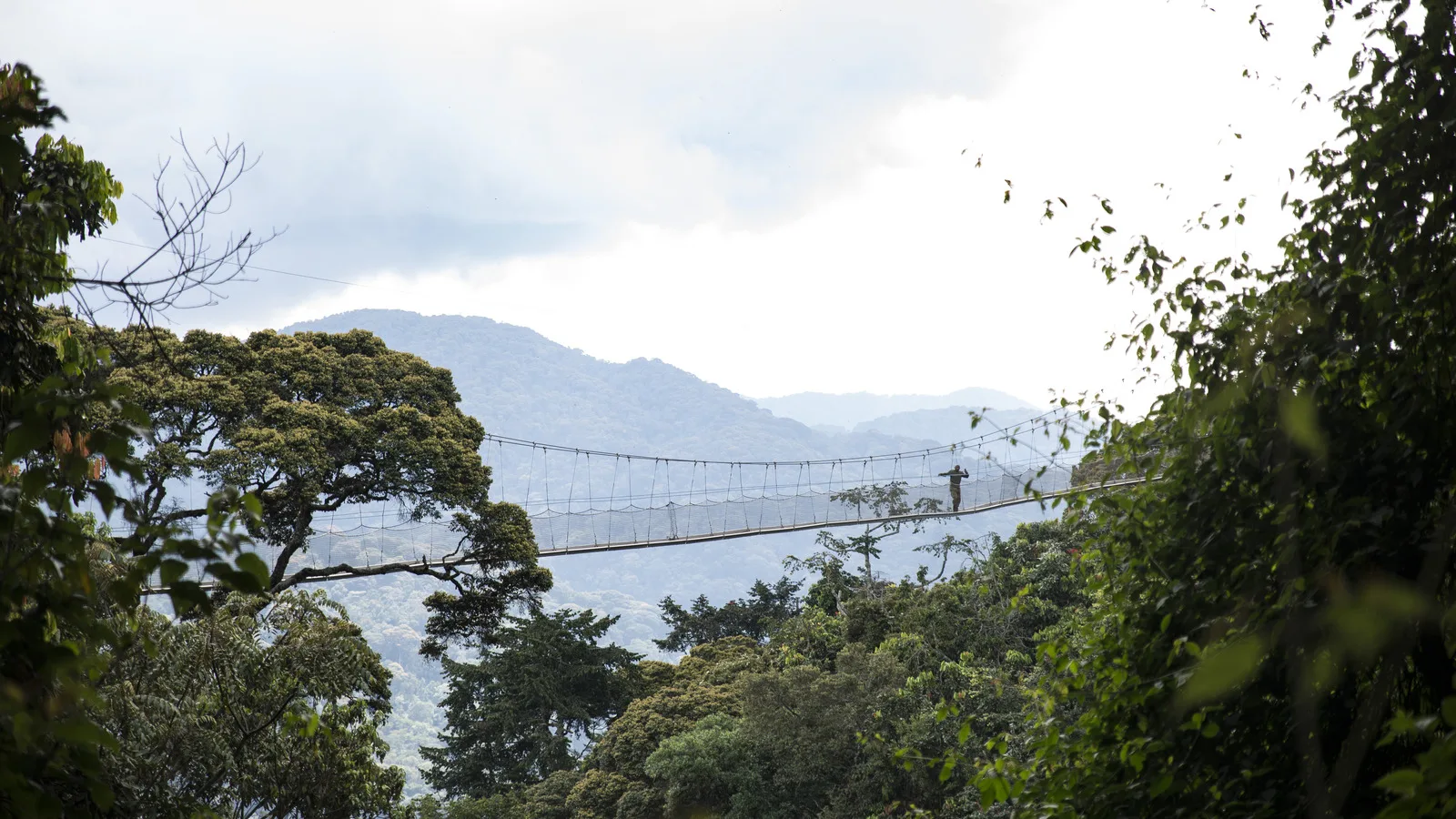
Credit Alex Niragira, CC BY-SA 4.0, via Wikimedia Commons
Nyungwe was inscribed on the World Heritage List in 2023 under criterion (x), the biodiversity criterion. It is the largest remaining montane rainforest in Rwanda and one of the largest in the Albertine Rift, and it is crossed by a main road.
What is there
The property covers 101,963.67 hectares in three separate blocks: the main Nyungwe Natural Forest and the smaller Cyamudongo and Gisakura forests. It runs from about 1,480 to 2,950 meters, and it is not only forest: there are high altitude wetlands, moors, thickets and grassland inside the boundary.
UNESCO records 1,468 species of vascular plants, 73 of them globally threatened, and 317 bird species, which makes it one of the most important bird conservation sites in Africa. African Parks, which manages the park, publishes somewhat different figures: over 1,100 plant species and 345 birds. Both are cited below. Surveys differ in method and date, and choosing one silently would be tidier than it would be true.
The primates are the reason most people come. One fifth of all of Africa's primate species are present, including eastern chimpanzee, golden monkey, the Albertine Rift race of the Angola colobus and L'Hoest's monkey. The Kamiranzovu swamp inside the park is thought to hold the second largest population of the Grauer's swamp warbler, a bird found only in the Albertine Rift.
The road
An international road crosses the property. UNESCO's own inscription describes it as completely illuminated and used by heavy truck and bus traffic, causing disturbance, wildlife mortality and pollution. An upgraded alternative road to the north is expected to reduce traffic through the park by around 60 per cent.
This is not a detail. A World Heritage rainforest with a lit highway through it is an unusual thing, and the road is how many visitors arrive.
It has also been the site of violence. The FCDO records that on 18 June 2023 two people were killed and six injured when suspected militants opened fire on a public passenger bus on the Nyamagabe to Rusizi road, in Nyungwe Forest. The park sits in the southwest, near a border the FCDO advises against all but essential travel to parts of. Check the current advice for your route rather than assuming the forest is remote from the region's politics.
How it is protected, and who pays for it
Nyungwe has been protected since 1933, first as a forest reserve, and became a national park in 2005. In October 2020 African Parks signed a twenty year management agreement with the Rwanda Development Board, so the park is run through a public private partnership rather than directly by government.
The financial arrangement is worth knowing because it is unusually explicit. Ten per cent of total park revenues go into a national fund for projects in communities next to the park, and a further five per cent into a guarantee fund that compensates people for damage caused by wildlife. Cooperatives around the park produce tea, milk, fish, livestock and honey, and one of them does surveillance.
The pressures UNESCO names are encroachment, illegal gold and coltan mining, and the road. Community fire awareness has reduced what was once a major threat.
Visiting
Nyungwe is walked, not driven. Chimpanzee and colobus tracking, the canopy walkway and a network of forest trails are the main activities, and all of them involve wet, steep ground. Chimpanzee tracking is the least predictable: the troops follow fruiting trees and are easier to find at some times of year than others.
The canopy walkway is the park's signature and is reached by a trail with descents and steps rather than from a car park.
Practical
- Boots with grip, and rain gear in any season
- Ask the park authority about chimpanzee movements for your specific dates
- Check the current advisory for the road you will use to arrive
- Expect the canopy walkway approach to be a trail, not a path from a car park
- Permits and fees through the Rwanda Development Board or your operator, in advance
Sources and references
- UNESCO World Heritage Centre: Nyungwe National Park
- African Parks: Nyungwe National Park
- UK FCDO: Rwanda regional risks
- Rwanda Development Board: parks, permits and tourism
Area, altitude, species counts, protection history and the description of the road are from the UNESCO inscription, read at source on 18 August 2026. Management arrangements and the alternative species figures are from African Parks. The 2023 attack is recorded by the UK FCDO.