Heritage
Royal Hill of Ambohimanga: Visitor and Heritage Guide
A royal city, a burial ground and a set of sacred places on a hill north of Antananarivo, still visited by pilgrims after five hundred years.
- Country Madagascar
- Category Heritage
- Reviewed 19 August 2026
- Sources 5
- Length 2 min read
Credit Heinonlein, CC BY-SA 4.0, via Wikimedia Commons
Ambohimanga is Madagascar's only inscribed cultural World Heritage property, and at 59 hectares with a 425 hectare buffer it is a modest thing on the map. It was inscribed in 2001 under criteria three, four and six: a royal city, a burial site and an ensemble of sacred places on a wooded hill some twenty kilometers north of Antananarivo.
UNESCO records that it has held its spiritual and sacred character, in ritual practice and in the popular imagination, for the past five hundred years, and that it remains a place of worship to which pilgrims come from Madagascar and from elsewhere. That last clause is the one to hold on to before you go.
The hill the Merina state came from
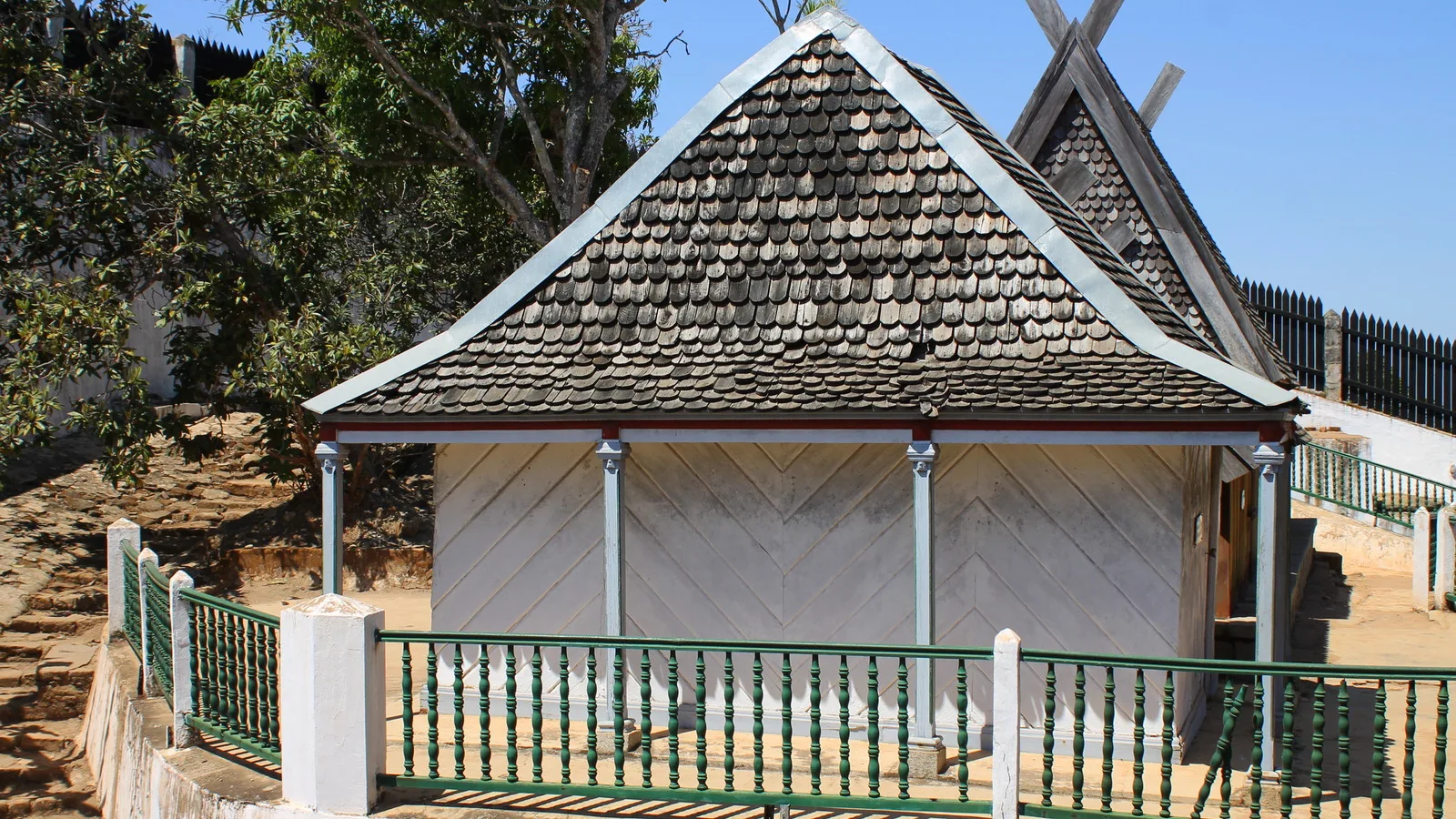
Ambohimanga was the seat of the Merina kings before Antananarivo was, and it is where Andrianampoinimerina consolidated the kingdom that went on to control most of the island in the nineteenth century. The royal compound at the top holds the timber houses, the tombs and the enclosures, all inside successive rings of wall and ditch with gateways that were closed each night with a stone disc.
What survives is not monumental in the way a stone city is. The material is wood, the scale is domestic, and the meaning is in what happened there rather than in what was built.
It is a sacred place, and that governs the visit
People come here to pray and to make offerings, and they were doing so long before it was inscribed. The site has fady attached to it, the local prohibitions this cluster's culture page describes, and a guide will tell you what they are on the day, because they can vary and they are not a formality.
Photograph the architecture and ask before photographing anyone praying. Do not enter a tomb enclosure unless you are taken into it. If you are asked to remove a hat or to leave something outside, do it without discussion.
If you go
- It is about twenty kilometers north of Antananarivo and is an easy half day.
- There is an entry fee and a local guide, and the guide is not optional.
- The climb through the compound is on uneven stone and steps.
- Ask about fady on arrival rather than assuming last year's answers hold.
- Go early. The hill catches the morning light and the crowds come later.
- Combine it with the Rova in the capital, which is the same story continued.
Reading it with the capital
Ambohimanga is where the Merina state began and the Rova of Antananarivo is where it ended up. Visiting one without the other leaves the arc incomplete, and the two are close enough to do in a day.
Sources
- UNESCO World Heritage Centre: Royal Hill of Ambohimanga
- UNESCO World Heritage Centre: Madagascar
- Madagascar culture and etiquette
- Madagascar and diaspora reconnection
- Madagascar destination guide
The inscription year, criteria, inscribed area, buffer zone and the description of five hundred years of sacred character were read from the UNESCO World Heritage Centre page for the Royal Hill of Ambohimanga on 19 August 2026.