Heritage
Madagascar and Diaspora Reconnection
Madagascar was settled from Borneo and from East Africa, and Malagasy people were later enslaved and shipped across the same ocean. A double history.
- Country Madagascar
- Category Heritage
- Reviewed 19 August 2026
- Sources 4
- Length 2 min read
Credit Rod Waddington, CC BY-SA 2.0, via Wikimedia Commons
Madagascar sits four hundred kilometers off the coast of Mozambique and its language belongs to a family whose nearest relatives are spoken in Borneo, six thousand kilometers away across open ocean. That sentence is the whole of why this article exists, and it takes some sitting with.
The island was settled from two directions, and both are still visible.
The crossing from the east
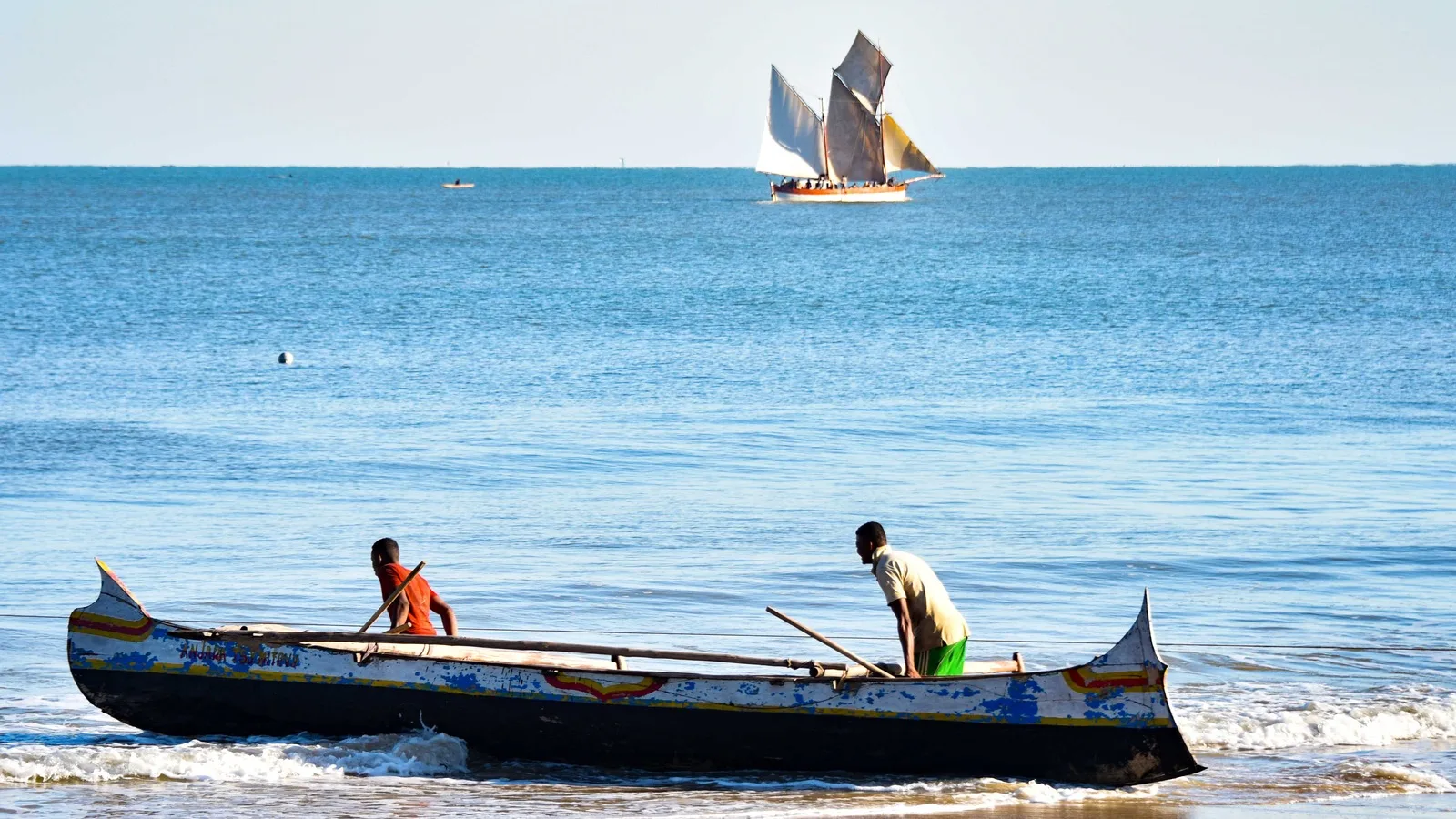
Malagasy is an Austronesian language, most closely related to the Barito languages of southeastern Borneo. The people who brought it crossed the Indian Ocean in outrigger canoes, and the outrigger is still the fishing boat of the Malagasy coasts today: the vessel in the photograph at the top of this page is the same design that made the crossing.
They brought more than a language. The rice terraces of the highlands, the banana, the taro, the yam and the chicken all came along the same route, which is why the middle of Madagascar looks more like Southeast Asia than like the continent it is closest to.
The crossing from the west
The other founding population came the short way, across the Mozambique Channel from East Africa, bringing cattle, the Bantu vocabulary that runs through Malagasy, and much of the ancestry of the coastal peoples. Genetic and linguistic studies consistently find both inheritances in the modern population, in proportions that vary by region.
Madagascar is therefore an African country whose language is Asian and whose people are both, and it does not experience that as a contradiction. It is one of the few places where the Indian Ocean world can be seen whole in a single population.
The Malagasy who were taken away
The second half of the story is why this page belongs on this site. From the seventeenth century, Malagasy people were enslaved in large numbers and shipped out: to the sugar estates of Mauritius and Reunion, to the Cape, to the Mascarenes generally, and across the Atlantic to the Americas, where Malagasy captives are recorded in Virginia, in the Caribbean and in Brazil.
Le Morne in Mauritius, which this site covers in its own cluster, names Madagascar among the origins of the people who escaped up that mountain. The Malagasy diaspora is therefore not only the one that arrived; it is also one that left, in chains, on the same sea.
Where to begin, if you are tracing a connection
Very little of this is digitized. Expect to travel, and expect to need someone who reads both languages.
- The National Archives in Antananarivo, for colonial and civil records.
- The Rova and the Andafiavaratra museum in the capital, for the Merina state.
- Ambohimanga, for the royal history the highlands are built around.
- The Mauritian and Reunionnais indenture and slavery archives, for those taken east.
- Published genetic studies, which are unusually informative for this island.
- A local guide and an interpreter. Records here are in Malagasy and French.
Sources
- UNESCO World Heritage Centre: Royal Hill of Ambohimanga
- Royal Hill of Ambohimanga: visitor and heritage guide
- UNESCO: intangible cultural heritage in Madagascar
- Madagascar destination guide
The Royal Hill of Ambohimanga inscription is the UNESCO record for the Merina royal history described here, and this site's own visitor guide to it is linked below. The wider Indian Ocean slave trade is covered in this site's Mauritius cluster.