Heritage
Saint Catherine Area: Visitor and Heritage Guide
The oldest working Christian monastery in the world, under a mountain that Judaism, Christianity and Islam all hold sacred.
- Country Egypt
- Category Heritage
- Reviewed 17 August 2026
- Sources 5
- Length 3 min read
Credit Berthold Werner, CC BY-SA 3.0, via Wikimedia Commons
Read the travel advice before you read the rest of this page. Saint Catherine sits on the line the Foreign Office draws across Sinai, and where exactly that line falls is the difference between a trip you can plan and one you cannot.
Where the travel advice draws its line
As it stood on 17 August 2026, the FCDO advises against all travel to the North Sinai Governorate, and against all but essential travel to the northern part of the South Sinai Governorate beyond the St Catherine to Nuweibaa road, except for the coastal strips on the west and east of the peninsula.
Read that clause carefully, because the monastery is on that road. The road is the boundary of the area advised against, not inside it. So Saint Catherine itself is not in the zone, and the country immediately north of it is. Both of those are worth knowing and neither survives a loose summary.
This is advice that changes, and the only sensible instruction is to read the current version yourself before booking and again before traveling. It is linked at the foot of this page.
What UNESCO inscribed
The Saint Catherine Area went onto the World Heritage List in 2002, and the property is 60,100 hectares. That figure is the first useful thing about it: the inscription is a mountain landscape with a monastery in it, not a building with a car park.
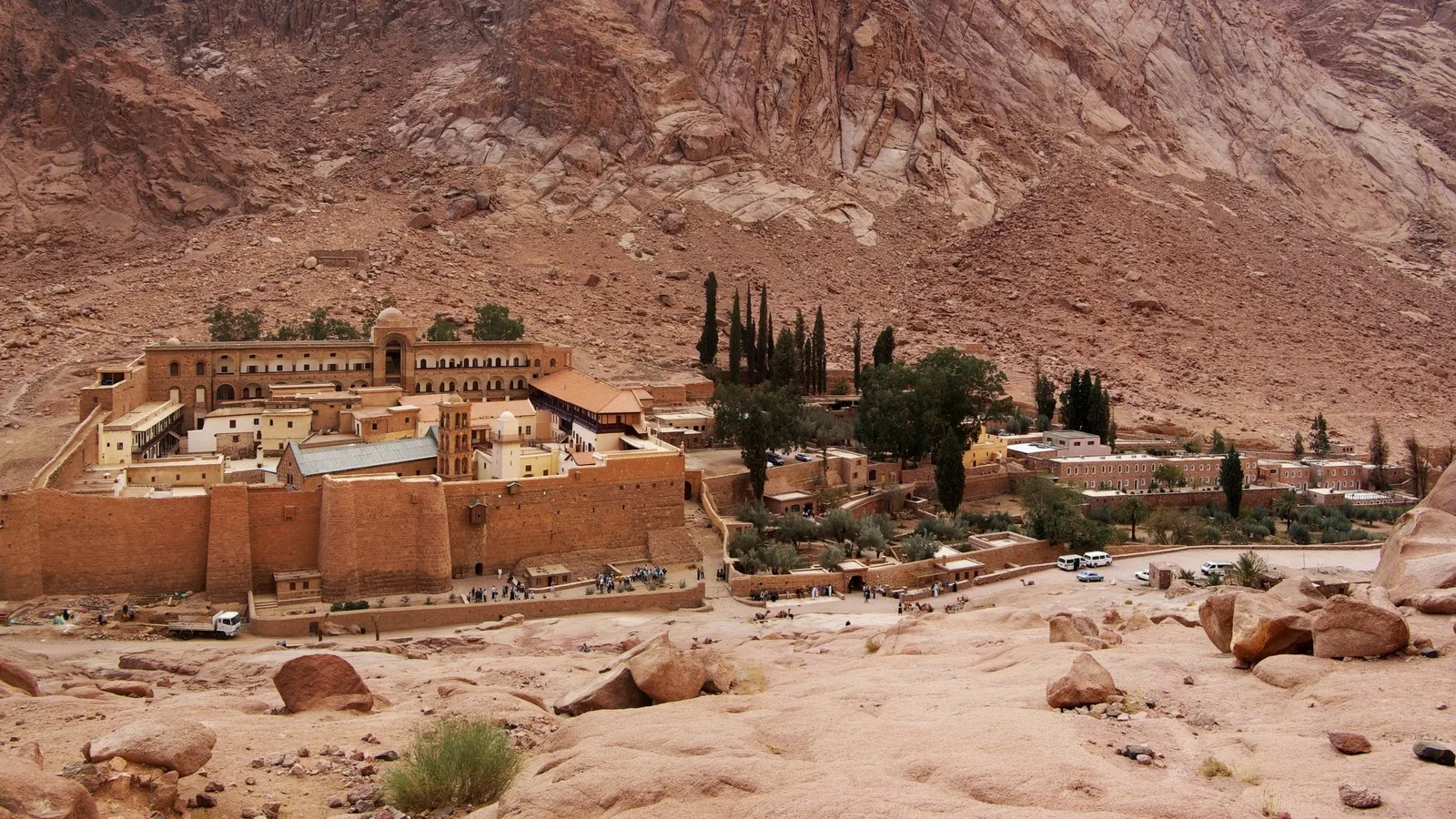
The Orthodox monastery stands at the foot of the mountain the Old Testament calls Horeb, where Moses is recorded as receiving the Tablets of the Law, and which Muslims know and revere as Jebel Musa. UNESCO states the consequence directly: the entire area is sacred to three monotheistic religions, Judaism, Christianity and Islam. Very few places on the World Heritage List carry that sentence.
The monastery was founded in the sixth century and is the oldest Christian monastery still in use for the purpose it was built for. Its Byzantine walls enclose buildings that matter to the study of Byzantine architecture, and it holds collections of early Christian manuscripts and icons that UNESCO calls outstanding.
The mountain itself
The ascent is part of the inscription rather than an add-on to it. The Path of Moses, Sikket Sayidna Musa, climbs to the summit past two arches, the Gate of Stephen and the Gate of the Law, and the remains of chapels along the way. The Holy Summit is an archaeological site in its own right, and it carries both a mosque and a chapel, which is the whole point of the place expressed in two small buildings.
UNESCO leans on the siting when it explains why this is inscribed at all: the monastery represents a deliberate attempt to bind natural beauty and remoteness on one side to human spiritual commitment on the other. That is why a photograph of the walls alone misses it, and why the picture at the top of this page is mostly mountain.
Practical notes
The three religions that hold this ground sacred do not all hold it sacred in the same way or for the same reasons. Arriving with that in mind is most of what respectful means here.
- Read the current FCDO advice for Sinai before booking and again before traveling
- This is a working Orthodox monastery. What is open, and when, follows its own calendar rather than a tourism one
- The manuscript and icon collections are not a general access museum. Do not assume you can see them
- The Path of Moses is a mountain ascent, and a pre dawn one if you are going up for sunrise. Cold, dark and steep
- The inscribed property is 60,100 hectares, so Saint Catherine names a region as well as a building
- Charges and opening arrangements are for the monastery and the Ministry of Tourism and Antiquities to publish, and are not printed here
Sources
- UNESCO World Heritage Centre: Saint Catherine Area, inscription 954
- UK FCDO: the parts of Egypt it advises against traveling to
- UK FCDO: Egypt regional risks
- UNESCO World Heritage Centre: Egypt, States Parties
- Egyptian Ministry of Tourism and Antiquities: the custodian of the monuments
The description, the criteria, the property size and the account of the Path of Moses are UNESCO’s own wording for inscription 954, read on 2026-08-17. The travel advice is the UK FCDO’s, read the same day, when the page had last been updated on 4 August 2026, and it changes. Opening arrangements and charges are for the monastery and the Ministry of Tourism and Antiquities to publish.