Heritage
Serengeti National Park: Visitor and Heritage Guide
One and a half million hectares of grassland, the largest unaltered migration left on earth, and the rocks that give it its shape.
- Country Tanzania
- Category Heritage
- Reviewed 19 August 2026
- Sources 3
- Length 2 min read
Credit Benoni95, CC BY-SA 4.0, via Wikimedia Commons
The Serengeti is the most written about landscape in Africa, which makes it hard to see. The inscription is a useful corrective because it is specific where the brochures are lyrical.
The property
Serengeti National Park covers 1,476,300 hectares of savannah and was inscribed in 1981 on criteria (vii) and (x).
UNESCO calls the migration the largest remaining unaltered animal migration in the world: over one million wildebeest and hundreds of thousands of other ungulates on a 1,000 km annual circular trek spanning Tanzania and Kenya. The setting it describes is 25,000 square kilometers of treeless short grassland dotted with rocky outcrops and cut by rivers and woodland.
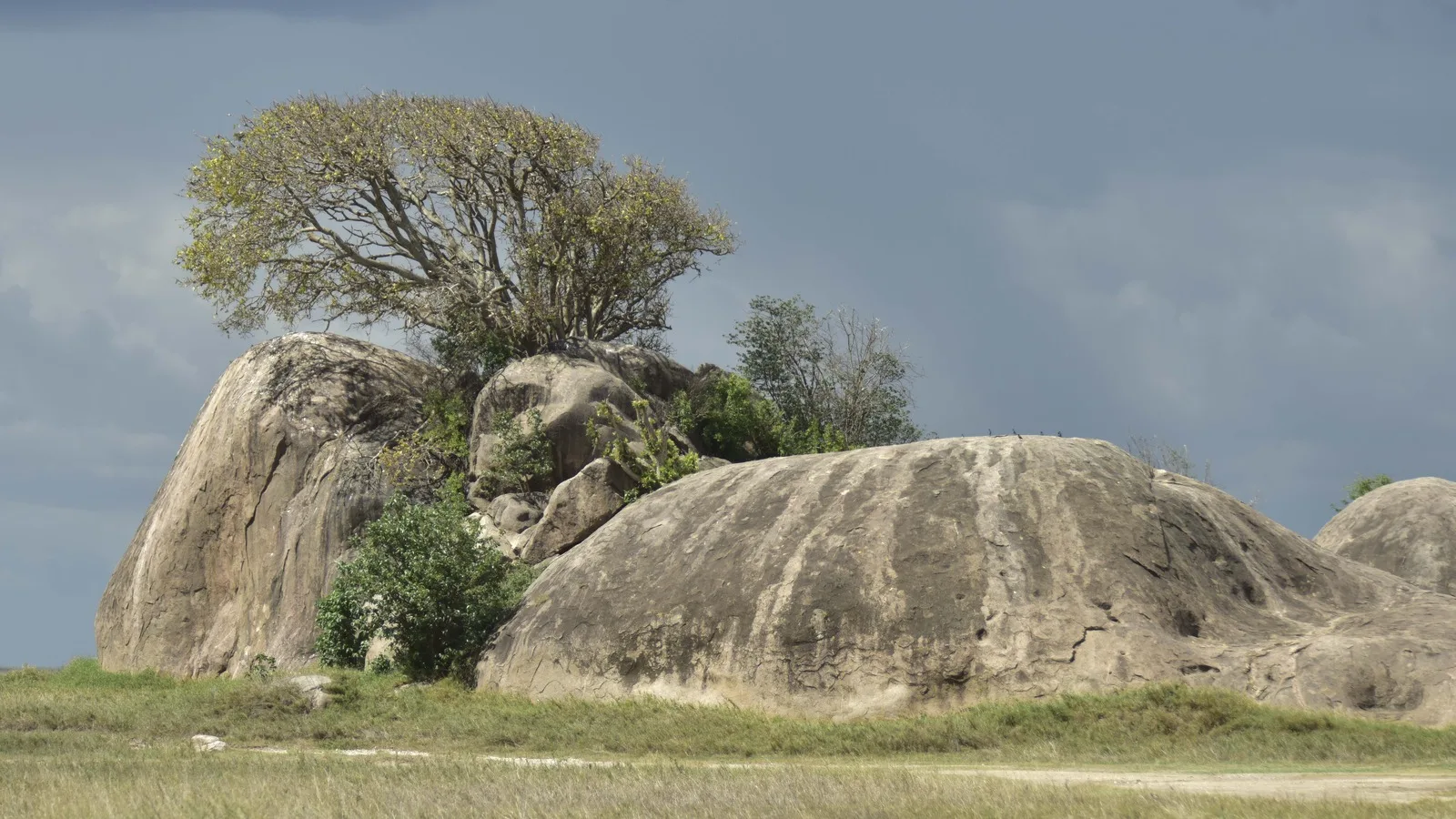
Kopjes, which are the reason it looks like that
Those rocky outcrops are kopjes, granite islands standing out of the grassland. They hold water and shade after the plains have dried, they carry vegetation the surrounding grass cannot support, and they are where the predators are in the middle of the day.
If you are looking at the Serengeti and wondering what to look at when there is no herd in front of you, the answer is usually the nearest kopje.
The numbers, and what they are for
The inscription records what it calls one of the most productive ecosystems on earth: two million wildebeest, 900,000 Thomson's gazelles and 300,000 zebras as the dominant herds, alongside elands, topis, hartebeests, buffalo, giraffe, warthog, waterbuck, elephant, hippopotamus and black rhinoceros, ten antelope species and ten primate species.
Among the predators it lists 4,000 lions, 1,000 leopards, 225 cheetahs, 3,500 spotted hyenas and 300 wild dogs. Over 500 bird species are present, five of them endemic to Tanzania, and the park holds the highest ostrich population in the country and probably in Africa.
Those are the figures the statement of Outstanding Universal Value carries. They describe the ecosystem the property was inscribed to protect rather than a census taken this year, and they should be read that way.
Seeing it well
- Work out which part of the migration circuit you want to be beside, rather than asking whether you will see it.
- The river crossings are a few weeks of a twelve month movement and are the most crowded thing in East African tourism.
- The calving on the southern plains is quieter and is a different season entirely.
- Watch the kopjes when the plains look empty.
- Park roads are dirt and can become impassable in the rains.
- Follow park regulations and the wardens, particularly on foot or at close range.
Sources and references
- UNESCO World Heritage Centre: Serengeti National Park
- Tanzania National Parks Authority
- UK FCDO: Tanzania regional risks
Every figure on this page is from the UNESCO statement of Outstanding Universal Value for the property, read on 19 August 2026, and describes the ecosystem at inscription rather than a current count.