Events and Festivals
Seychelles Festivals and Celebrations
Moutya is a dance that enslaved Africans performed at night in the forest, out of earshot of the plantation house. UNESCO inscribed it in 2021.
- Country Seychelles
- Category Events and Festivals
- Reviewed 20 August 2026
- Sources 2
- Length 2 min read
Credit So Seychelles, CC BY 2.0, via Wikimedia Commons
One Seychellois tradition on UNESCO's Representative List is documented in enough detail to write about properly, and it is the most remarkable entry in this entire seven-country series.
Moutya
UNESCO inscribed moutya in 2021. Its account is worth reading closely.
Moutya was brought to Seychelles by the enslaved Africans who arrived with the French settlers in the early eighteenth century. They danced it, in UNESCO's words, at night in the forest, at a distance from the plantation house where their masters lived. Historically it was a psychological comfort against hardship and poverty and a means of resisting servitude and social injustice.
That is not a folk tradition with a difficult backstory. That is a form invented as resistance, in secret, by people who had been transported, and it is still danced.
How it is performed
The calling of social commentary by men in the crowd, answered by the dancers, is the part that carries the history. A form that began as covert commentary on a plantation kept its commentary when it stopped needing to be covert.
- It is traditionally performed around a bonfire, and it begins with the drums being heated over that fire.
- The instrument is a large drum with a narrow rim, made of goat hide, played mostly by men.
- Once the drums are warm the drummers set the beat, and men in the crowd call out themes, usually social commentaries.
- The female dancers respond in high-pitched tones, and the dance moves at a moderate tempo with hip-swaying and feet-shuffling.
- The dancers come close but do not physically touch.
- It is usually performed spontaneously within the community as well as at social gatherings and cultural events, and it is passed on informally through performance, observation and imitation.
What we cannot tell you
Two gaps, and we would rather name them than paper over them.
UNESCO's intangible heritage state page for Seychelles does not load. We tried it twice through two routes on 20 August 2026 and it returned an error both times, where the equivalent page for other countries loaded normally. So we cannot tell you how many Seychellois traditions are inscribed, only that moutya is one of them.
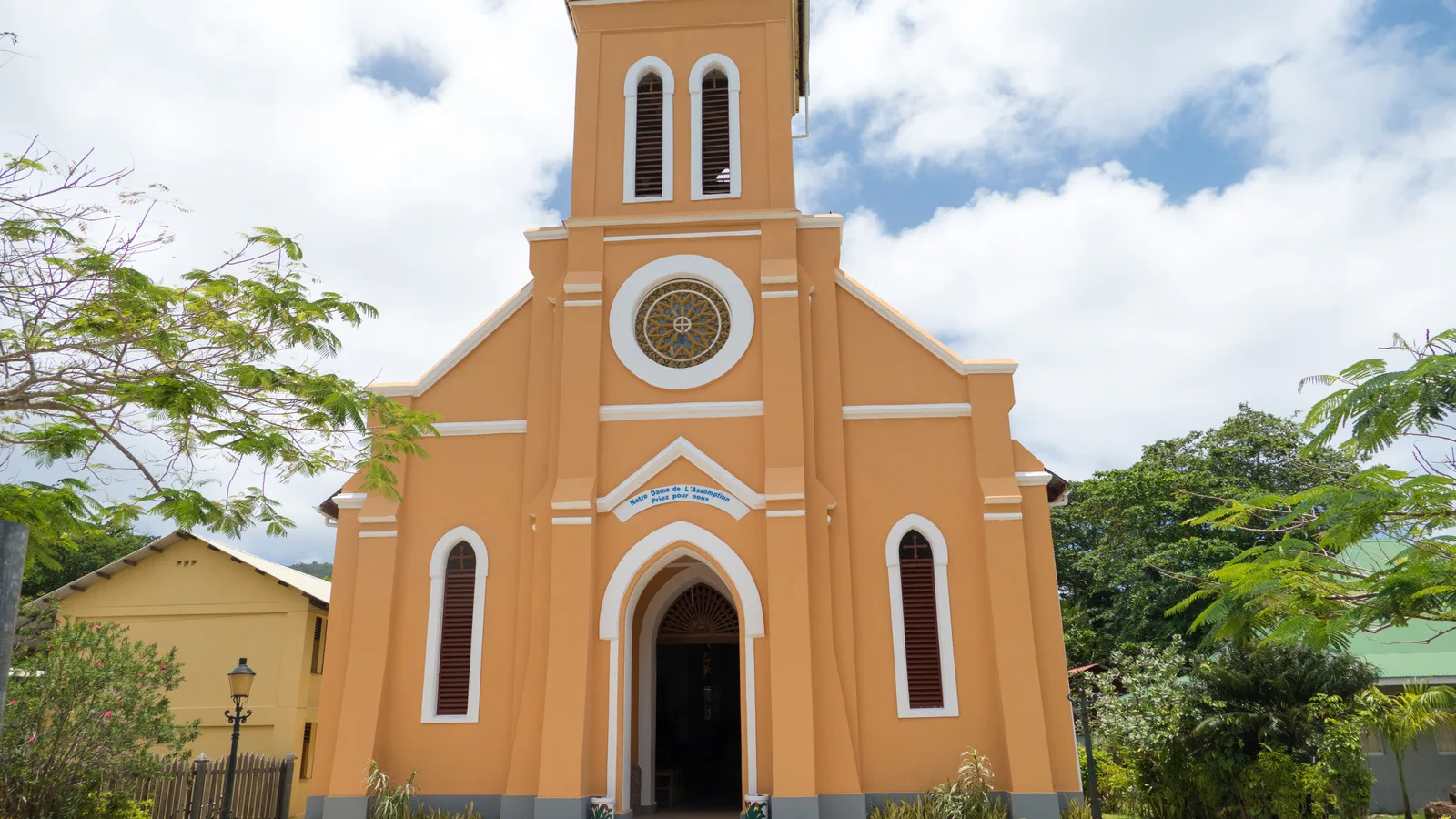
And we have no sourced calendar of Seychellois festivals. The photograph on this page is the church of Notre Dame de l'Assomption on La Digue, which is a real Seychellois landmark, but nothing we read tells us how the Assumption is kept in Seychelles, so we are not going to describe it.
Sources
Every statement about moutya is from UNESCO's 2021 inscription on the Representative List of the Intangible Cultural Heritage of Humanity, read 20 August 2026. The reference to traditional dance on Silhouette is from Seychelles' own Tentative List submission and is attributed to Seychelles.