Seychelles
Two World Heritage sites, both of them natural, and neither of them a beach
- Region Indian Ocean Islands
- Country Seychelles
- Type Country
- Reviewed 11 August 2026
- Sources 4
- Length 4 min read
Credit Bram Wouters, Unsplash
Why Seychelles
Seychelles is sold as a beach, and the beaches are as good as the pictures. UNESCO lists two properties here and classes both as natural. Neither is a beach.
One is a raised coral atoll far out in the western Indian Ocean, so remote that it has been left more or less alone. The other is nineteen and a half hectares of palm forest in the middle of Praslin. Between them they hold the largest population of giant tortoises in the world and the largest seed in the plant kingdom, and getting to either requires deciding to.
Aldabra
Aldabra is four large coral limestone islands separated by narrow passes, enclosing a shallow lagoon full of smaller islands, with a fringing reef around the whole thing. Most of its land surface is ancient coral reef, about 125,000 years old, raised above the sea repeatedly. Remoteness has done what management usually has to: it is close to intact.
The detail worth carrying away is structural. On Aldabra the top of the terrestrial food chain is a herbivore. Giant tortoises graze grasses and shrubs, and some of those plants have evolved in response to being grazed by them. There are over 100,000 of the tortoises, the largest population anywhere and entirely self-sustaining, and around them more than 400 endemic species and subspecies, the second largest frigatebird colonies in the world and one of only two oceanic flamingo populations.
The Vallée de Mai
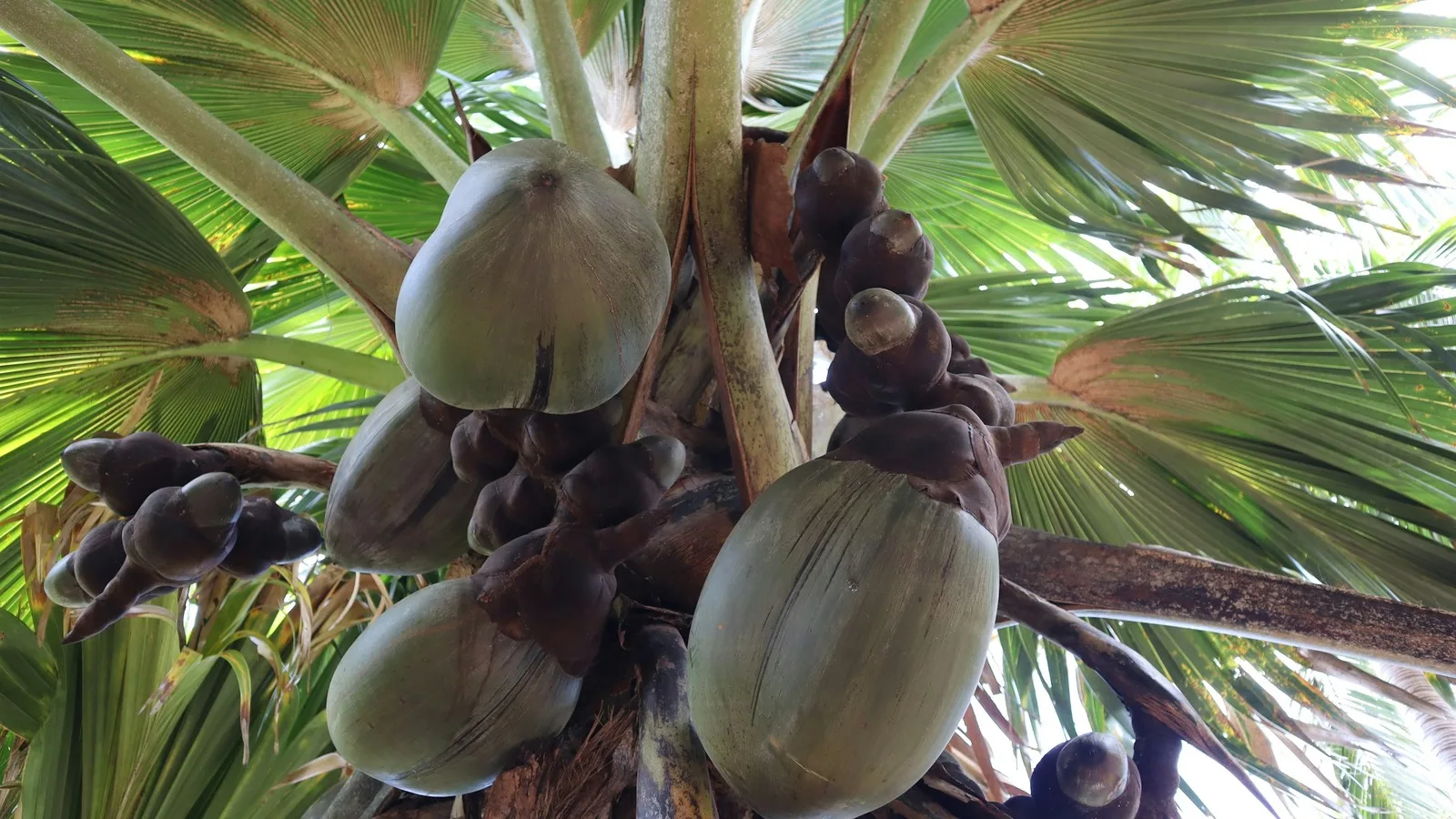
On Praslin, the Vallée de Mai is a small area of palm forest that has changed very little since prehistoric times. It holds the world’s largest population of coco de mer, whose double nut contains the largest seed of any plant, along with five other endemic palms. It is the only place in Seychelles where all six grow together.
UNESCO reads the forest as a living illustration of what tropical vegetation looked like before more advanced plant families arrived. The black parrot lives here and nowhere else, entirely dependent on this forest and the palm woodland around it. The management problem is theft: seeds are taken and sold, so a key part of looking after the place is collecting and planting them before that happens.
Food
Seychellois cooking is Creole and it is built on fish. Grilled red snapper or job with chilli and lime is the plain version and the best one. Octopus curry, cooked with coconut milk until it gives way, is the dish most people name, and ladob covers both a savoury dish and a pudding of plantain and sweet potato in sweetened coconut milk.
Practical orientation
Seychellois Creole, English and French are all official, and Creole is what is spoken at home. The currency is the rupee. It is warm all year. The three main islands are linked by ferry and short flights, and the outer islands, Aldabra among them, are a different order of journey altogether.
Entry requirements vary by nationality and change. Immigration and Civil Status is the authority on them, and this page is not.
Sources and references
- UNESCO World Heritage Centre: Aldabra Atoll
- UNESCO World Heritage Centre: Vallée de Mai Nature Reserve
- UNESCO Intangible Cultural Heritage: Moutya
- Immigration and Civil Status, Republic of Seychelles
These are the authoritative references for the heritage this page discusses; each was checked at source on 11 August 2026. Practical details (entry rules, health guidance, opening times) change constantly. The bodies listed here are authoritative and this page is not.