Mauritania
Two World Heritage sites, nine intangible elements, and a north the advisory closes
- Region West Africa
- Country Mauritania
- Type Country
- Reviewed 14 August 2026
- Sources 5
- Length 4 min read
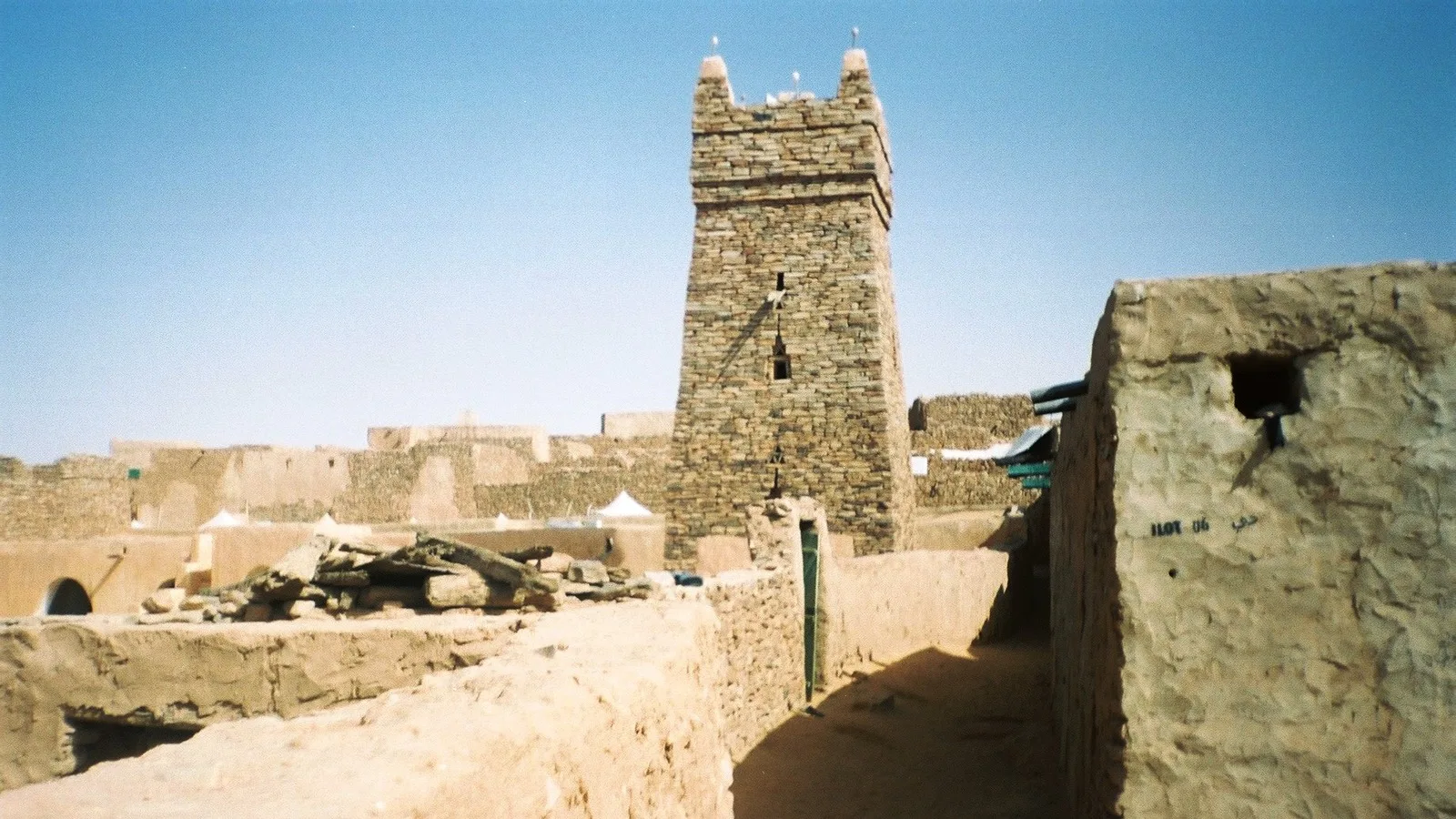
Credit Radosław Botev, CC BY 3.0, via Wikimedia Commons
Why Mauritania
A desert republic on the Atlantic, where the Sahara meets the ocean and the Senegal River marks the southern border.
The photograph at the top of this page is the mosque at Chinguetti, one of the four ksour that make up the country’s cultural inscription. The square stone minaret and the dry stone lanes around it are exactly what the UNESCO citation describes, which is rarer in this work than it sounds.
The two inscriptions
Banc d’Arguin National Park was inscribed in 1989 under criteria nine and ten. It fringes the Atlantic coast and comprises sand dunes, coastal swamps, small islands and shallow waters, and UNESCO describes the contrast between the harsh desert and the biodiversity of the marine zone as the reason for the listing. A wide variety of migrating birds winters there. The citation records that the fishermen work with dolphins to attract shoals.
The Ancient Ksour of Ouadane, Chinguetti, Tichitt and Oualata were inscribed in 1996 under criteria three, four and five. UNESCO dates their founding to the eleventh and twelfth centuries, to serve the caravans crossing the Sahara, and describes them as trading and religious centers that became focal points of Islamic culture. The urban fabric that survives evolved between the twelfth and sixteenth centuries: houses with patios crowding narrow streets around a mosque with a square minaret.
Three more sites sit on the Tentative List, all filed in 2001, and all three are archaeological: Azougui, Kumbi Saleh and Tegdaoust.
Food
Mutton and rice carry the center of the table, and the fish of one of the richest fishing grounds in the world reaches inland less than the map would suggest. Dates come from the oases. Tea is made in three rounds, poured from height, and the making of it is the occasion rather than an accompaniment to one.
Practical orientation
Arabic is the official language, and Pulaar, Soninke and Wolof are spoken in the south. The currency is the ouguiya. Nouakchott, on the coast, has the international airport.
Entry requirements vary by nationality and change. This page is not the authority on them.
This page states no entry, health or security requirements, and is not advice. Check your own government’s current guidance before making any decision.
Sources and references
- UNESCO World Heritage Centre: Mauritania, States Parties and Tentative List
- UNESCO World Heritage Centre: Ancient Ksour of Ouadane, Chinguetti, Tichitt and Oualata
- UNESCO World Heritage Centre: Banc d Arguin National Park
- UNESCO Intangible Cultural Heritage: Moorish epic T heydinn
- US Department of State: Mauritania Travel Advisory
These are the authoritative references for the heritage this page discusses; each was checked at source on 14 August 2026. Practical details (entry rules, health guidance, opening times) change constantly. The bodies listed here are authoritative and this page is not.