Getting Around Madagascar
- Country Madagascar
- Guide Flight Planning
- Reviewed 19 August 2026
- Length 2 min read
Credit Jean-Louis Vandevivere, CC BY 2.0, via Wikimedia Commons
Last reviewed 19 August 2026
Distances in Madagascar are measured in days rather than kilometers. The island is roughly the size of France and Belgium together, the main roads are few, and a hundred kilometers can take four hours or eight depending on the surface and the season. Any itinerary that treats it as a small island will fail on the first leg.
The taxi-brousse, and what the FCDO says about it
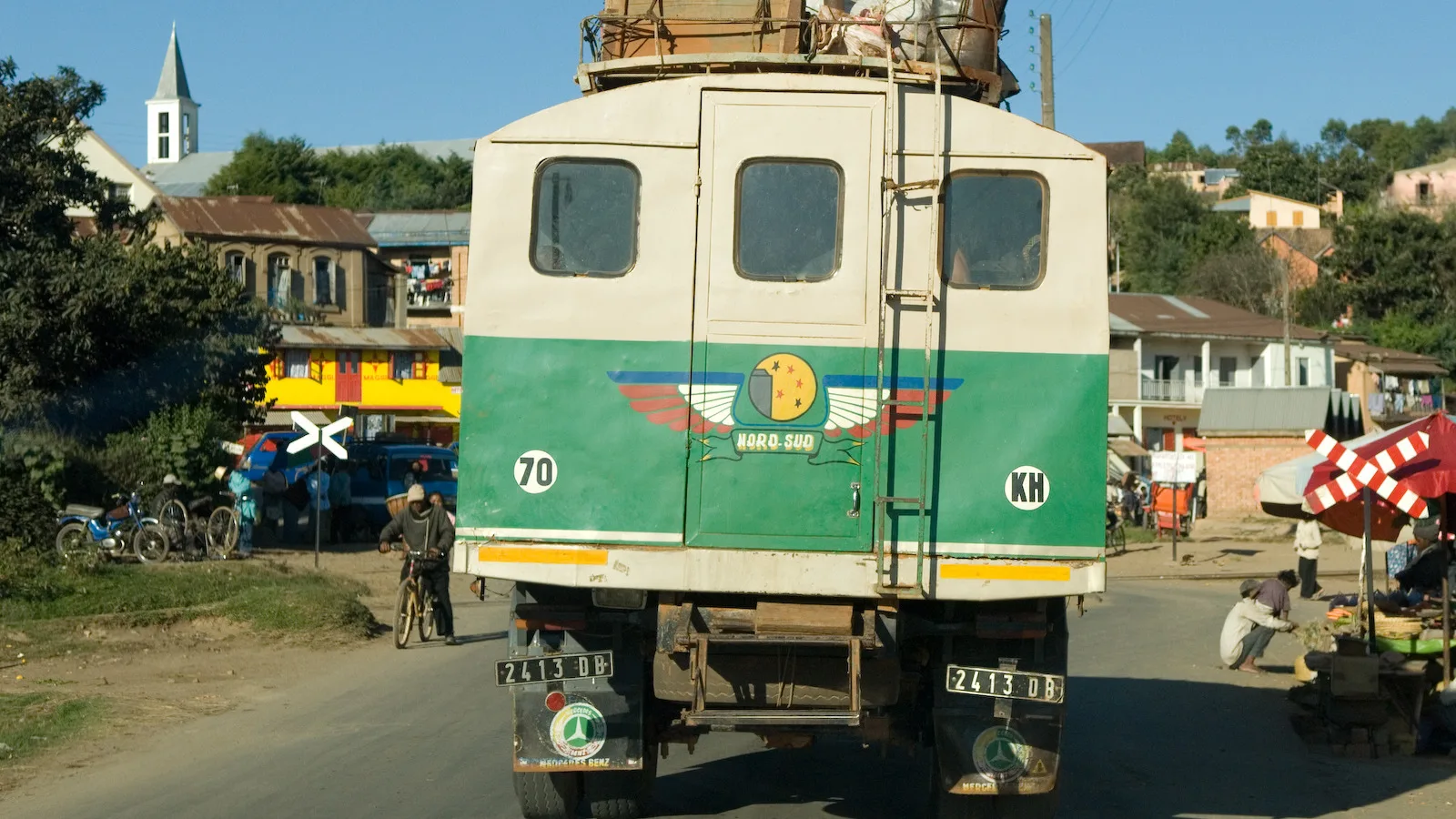
The taxi-brousse is the shared minibus that connects everywhere to everywhere, leaves when it is full rather than when it is scheduled, and is how most Malagasy people travel. It is also the subject of an unambiguous warning: the Foreign, Commonwealth and Development Office advises avoiding multi-passenger taxi vans because of the risk of robbery.
That advice is set out here as it is written rather than softened. A reader who chooses to travel that way should do it knowing what their own government says, and a reader who would rather not should know that the alternative is a private car or a domestic flight.
Driving, and flying
Armed robbery on main roads is frequent, particularly at night and outside the major towns, and the FCDO suggests driving in convoy where possible. The practical upshot for most visitors is a hired vehicle with a local driver, which is normal here, is not expensive by European standards, and solves the road knowledge problem as well as the security one.
Domestic flights link the capital with the main regional centers and turn a three day drive into an hour. They are also subject to cancellation and rescheduling, so never book a flight home for the day after a domestic connection.
Getting around without stress
- Hire a vehicle with a driver rather than self-driving.
- Do not travel between towns after dark.
- Build slack into the itinerary. Everything takes longer than the map suggests.
- Carry your passport. Police make random identity checks and do not always accept copies.
- Ask for identification if you are stopped by someone claiming to be police.
- Never book an international flight the day after a domestic one.