Heritage
Kilwa Kisiwani and Songo Mnara: Visitor and Heritage Guide
Two Swahili port cities that minted their own coinage, roofed a mosque in domes, and were called the most beautiful in the world.
- Country Tanzania
- Category Heritage
- Reviewed 19 August 2026
- Sources 4
- Length 3 min read
Credit Richard Mortel, CC BY 2.0, via Wikimedia Commons
Almost nobody goes to Kilwa. It is the single clearest surviving statement that this coast was a center of the medieval world rather than an edge of it, and it sits on two small islands about 300 km south of Dar es Salaam.
UNESCO inscribes the two islands together, under the name Ruins of Kilwa Kisiwani and Ruins of Songo Mnara.
What was here
Kilwa Kisiwani was occupied from the 9th to the 19th century and reached its height in the 13th and 14th. Its prosperity, and Songo Mnara's, rested on control of Indian Ocean trade with Arabia, India and China: gold and ivory from the hinterland exchanged for silver, carnelians, perfumes, Persian faience and Chinese porcelain.
Kilwa minted its own currency from the 11th to the 14th century. In 1331 the traveler Ibn Battuta stopped here and described Kilwa as one of the most beautiful cities of the world.
In the 16th century the Portuguese built a fort on the island and the decline of both places began.
What is standing
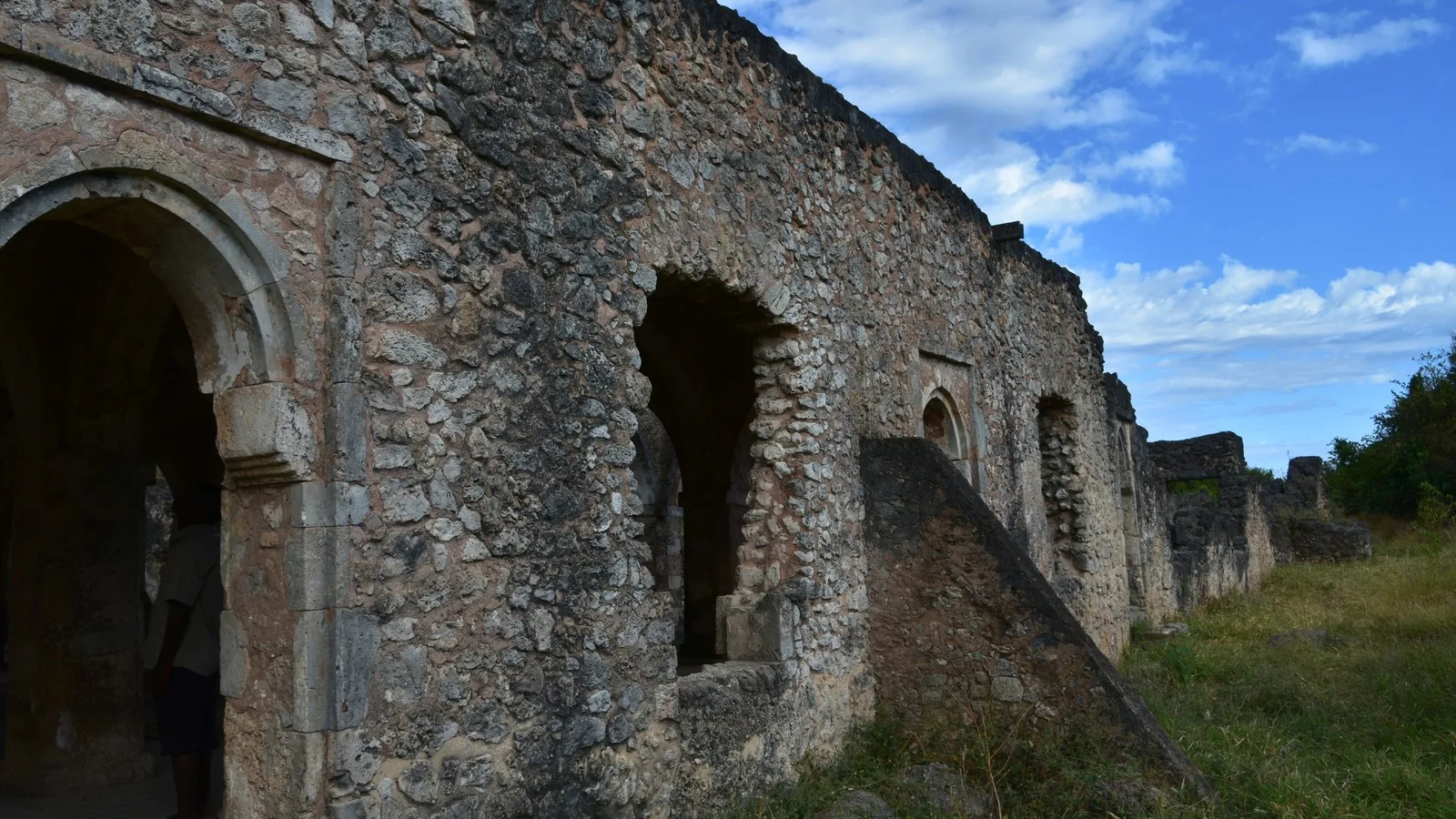
The remains cover much of Kilwa Kisiwani and much of the city is still unexcavated. The substantial standing ruins are built of coral and lime mortar and include:
- the Great Mosque, built in the 11th century and considerably enlarged in the 13th, roofed entirely with domes and vaults, some of them decorated with embedded Chinese porcelain;
- Husuni Kubwa, the palace built between about 1310 and 1333, with its large octagonal bathing pool;
- Husuni Ndogo, numerous mosques, and the Gereza, built on the ruins of the Portuguese fort;
- an entire urban complex of houses, public squares and burial grounds.
At the northern end of the second island, Songo Mnara holds the remains of five mosques, a palace complex and some thirty-three domestic dwellings, built of coral stone and wood inside enclosing walls.
The porcelain set into the domes is the detail worth carrying. It is Chinese, it is in the ceiling of an East African mosque, and it was put there in the 13th century.
Inscribed in 1981, in danger from 2004 to 2014
The property was inscribed in 1981 on criterion (iii) as a serial property of two components.
It was placed on the List of World Heritage in Danger in 2004 and removed in 2014. That second date is worth holding: Kilwa left the Danger List in the same year that the Selous joined it, and the two events are the whole recent conservation history of this country in one line.
Getting there, and one thing about the map
Both sites are islands and are reached by boat, and the ground is uneven. It is most of a day from anywhere, and that is the reason it is empty.
One clarification, because the geography is easy to get wrong. Kilwa is in Lindi region. The FCDO advises against all but essential travel to a strip within 20 km of the Mozambique border, which is much further south. Kilwa is not inside that advisory. A reader who sees "southern Tanzania" and stops there gives up a World Heritage site for no reason.
Sources and references
- UNESCO World Heritage Centre: Ruins of Kilwa Kisiwani and Ruins of Songo Mnara
- UK FCDO: Tanzania regional risks
- Tanzania: a land that echoes with rich and diverse history and heritage
- UNESCO: the List of World Heritage in Danger
The chronology, the trade goods, the buildings, the criterion and the Danger List years are all from the UNESCO inscription for the property, read on 19 August 2026. The travel advisory boundary is from the UK FCDO regional risks page.