Events and Festivals
Madagascar Festivals and Celebrations
Four traditions on the UNESCO lists, a music culture that fills the highlands and the southwest, and a calendar that mostly is not one.
- Country Madagascar
- Category Events and Festivals
- Reviewed 19 August 2026
- Sources 5
- Length 2 min read
Credit Hopeandlink, CC BY-SA 4.0, via Wikimedia Commons
Madagascar has four elements on the UNESCO Representative List of the Intangible Cultural Heritage of Humanity, and three of the four are performing arts. What it does not have is a festival calendar a visitor can book around: most of what matters here happens for a reason, in a place, when a family or a village decides it will.
Hiragasy
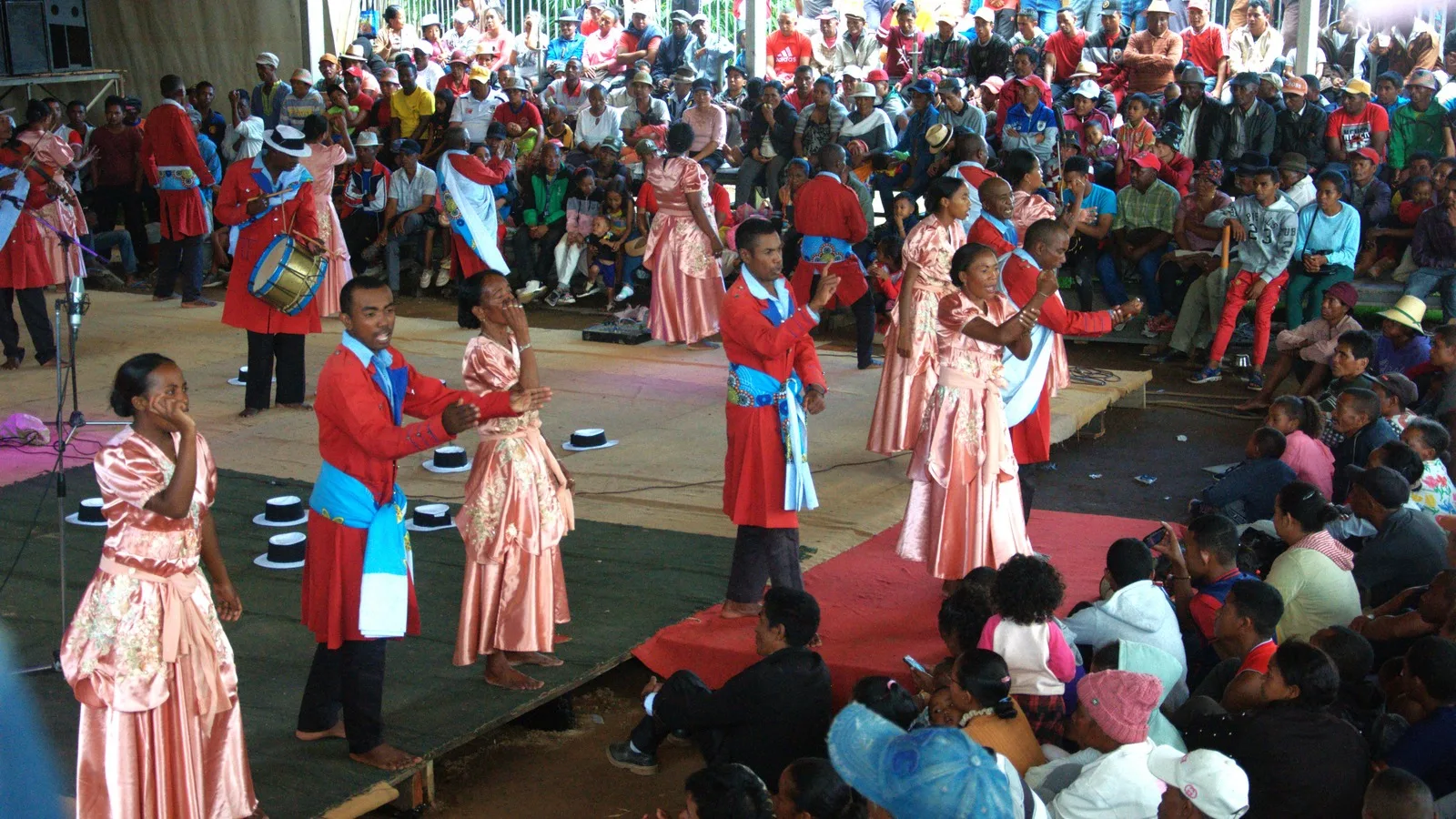
Hiragasy is the performing art of the central highlands and it is the thing to see if you can. A troupe performs for hours: oratory first, then singing, then dancing, with valiha and drums and violins, in bright red and pink costume, before a crowd seated in a ring on the ground.
It is not a concert. It is closer to a village court in which the entertainment carries the argument, and the speeches at the start are the kabary this cluster's culture page describes. Troupes perform at festivals, at famadihana, at political gatherings and at hired occasions, mostly around Antananarivo and the highland towns.
Tsapiky, kabary and the Zafimaniry
Tsapiky is the music of the southwest around Toliara: fast, electric, guitar driven, played at funerals and at parties, and loud enough to carry across a town. It is a living popular music rather than a heritage performance, which makes its inscription unusual and welcome.
Malagasy Kabary is the oratorical art. Woodcrafting knowledge of the Zafimaniry, inscribed in 2008, is the carved geometric joinery of the Zafimaniry people in the southeastern highlands, applied to house frames, shutters, doors and stools, and it is the only one of the four you can take home.
Where a visitor might actually see something
- Around Antananarivo and the highland towns for hiragasy troupes.
- Around Toliara and the southwest for tsapiky, especially at weekends.
- Ambositra and the Zafimaniry villages for the woodcarving.
- Independence Day on 26 June, which is celebrated everywhere.
- Alahamady Be, the Malagasy new year, in March.
- Ask a lodge or a guide. Almost nothing here is published in advance.
Being present without being a problem
Most of these are occasions rather than performances. Ask before photographing, expect to be refused sometimes, and do not pay to have something staged for you. If you are invited to a family occasion, go, follow whoever invited you, and contribute what they suggest rather than what you think is generous.
The one rule that matters everywhere: a funeral, a famadihana or a tomb is not a sight. It is attended by invitation or not at all.
Sources
- UNESCO: intangible cultural heritage in Madagascar
- UNESCO: Hiragasy, a performing art of the Central Highlands of Madagascar
- UNESCO: Tsapiky, of the South West region of Madagascar
- UNESCO: Malagasy Kabary, the Malagasy oratorical art
- UNESCO: Woodcrafting knowledge of the Zafimaniry
All four elements are on the UNESCO Representative List of the Intangible Cultural Heritage of Humanity. The Zafimaniry woodcrafting knowledge was inscribed in 2008, Malagasy Kabary in 2021, Hiragasy in 2023 and Tsapiky in 2025. Every year was read from the element's own page on 19 August 2026. No festival dates are given because almost none of them are fixed.