Events and Festivals
Mauritius Festivals and Celebrations
Four UNESCO-inscribed traditions and a public calendar that belongs to four religions at once. What Mauritius celebrates, and when it moves.
- Country Mauritius
- Category Events and Festivals
- Reviewed 19 August 2026
- Sources 5
- Length 2 min read
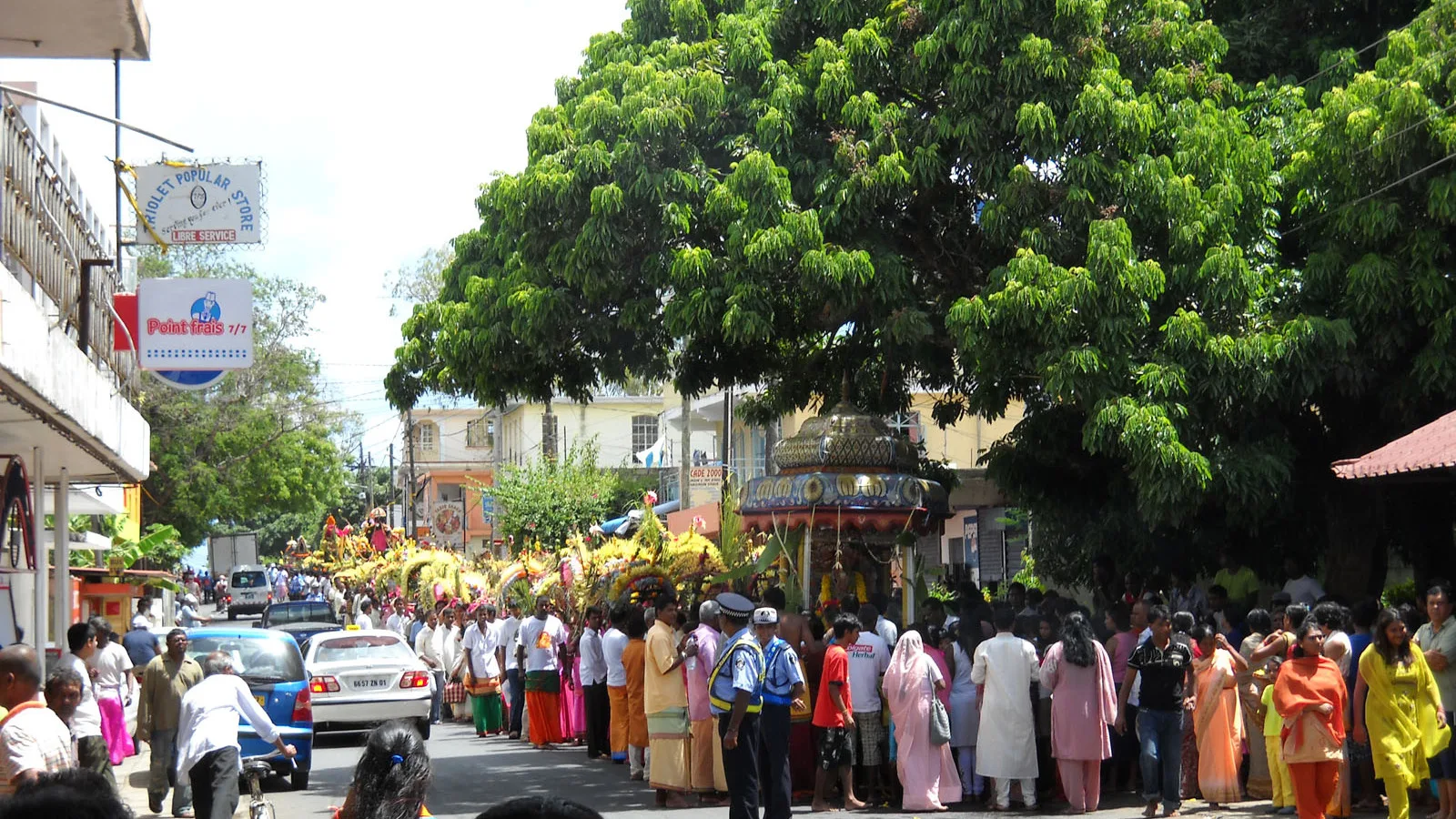
Credit carrotmadman6 from Mauritius, CC BY 2.0, via Wikimedia Commons
Mauritius has four traditions inscribed by UNESCO and a public holiday calendar that no single community owns. Hindu, Catholic, Muslim, Tamil and Chinese festivals are all national holidays, and a Mauritian will commonly attend one that is not their own because a neighbor invited them.
Almost none of it falls on a fixed date. That is the single most important practical fact on this page.
Sega, and its three relatives
Traditional Mauritian Sega was inscribed on the Representative List in 2014. It is the music and dance of the enslaved: a goatskin drum called the ravanne, a triangle, a rattle, and a step danced with the feet barely leaving the ground, because in its origins the dancers were shackled.
Sega tambour of Rodrigues Island followed in 2017, faster and more percussive than the Mauritian form. Bhojpuri folk songs in Mauritius, Geet-Gawai, were inscribed in 2016: pre-wedding songs carried from north India by indentured laborers and sung by women in the bride's house.
Sega tambour Chagos, and why it is listed differently
The fourth was inscribed in 2019, and not on the same list. Sega tambour Chagos is on the Urgent Safeguarding List, which is the list for elements at risk of ceasing to be practiced. It belongs to the Chagossian community, who were removed from their islands and largely resettled in Mauritius, and it is sung by people practicing the music of a place they cannot go home to.
A page that counted this as one of four UNESCO traditions and moved on would have said something technically true and substantially false. It is listed differently because it is differently placed.
The festivals a visitor is most likely to meet
Every one of these moves against the Gregorian calendar. Check the year you are traveling rather than trusting a list, including this one.
- Thaipoosam Cavadee, when Tamil devotees carry decorated arches in procession.
- Maha Shivaratree, when hundreds of thousands walk to Ganga Talao carrying kanwars.
- Divali, when the whole island puts lamps outside the door.
- Eid al-Fitr, marked nationally at the end of Ramadan.
- The Chinese Spring Festival, loudest in Port Louis.
- The Père Laval pilgrimage in September, and Ougadi, Ganesh Chaturthi and Holi through the year.
Two days that are not festivals
The first of February is the abolition of slavery. The second of November is the arrival of the indentured laborers. Both are national holidays, both are commemorations rather than celebrations, and both are marked at the sites this cluster covers: Le Morne for the first, Aapravasi Ghat for the second.
If you are on the island for either, going is welcome. Treating it as an event is not.
Sources
- UNESCO: intangible cultural heritage in Mauritius
- UNESCO: Traditional Mauritian Sega
- UNESCO: Sega tambour of Rodrigues Island
- UNESCO: Bhojpuri folk songs in Mauritius, Geet-Gawai
- UNESCO: Sega tambour Chagos, Urgent Safeguarding List
Every inscription year above was read from the UNESCO intangible cultural heritage record for Mauritius and from each element's own page, on 19 August 2026. No festival dates are given because none of them are fixed.