Mauritius
Two World Heritage sites, and both of them are about how people got here
- Region Indian Ocean Islands
- Country Mauritius
- Type Country
- Reviewed 11 August 2026
- Sources 3
- Length 4 min read
Credit Anton Marchuk, via Unsplash
Why Mauritius
Mauritius is sold as a beach and it has excellent ones. It is also a country with two World Heritage sites, both about how people came to be on the island, and neither about leisure.
Nobody is indigenous to Mauritius. There was no human population here when the Dutch, then the French, then the British took the island, and every Mauritian alive is descended from somebody who arrived: enslaved people brought from Madagascar, mainland Africa, India and South East Asia; indentured workers contracted from India; traders and settlers from France, Britain and China. The result is a country whose ordinary life is genuinely plural, and whose landscape holds the evidence.
Le Morne
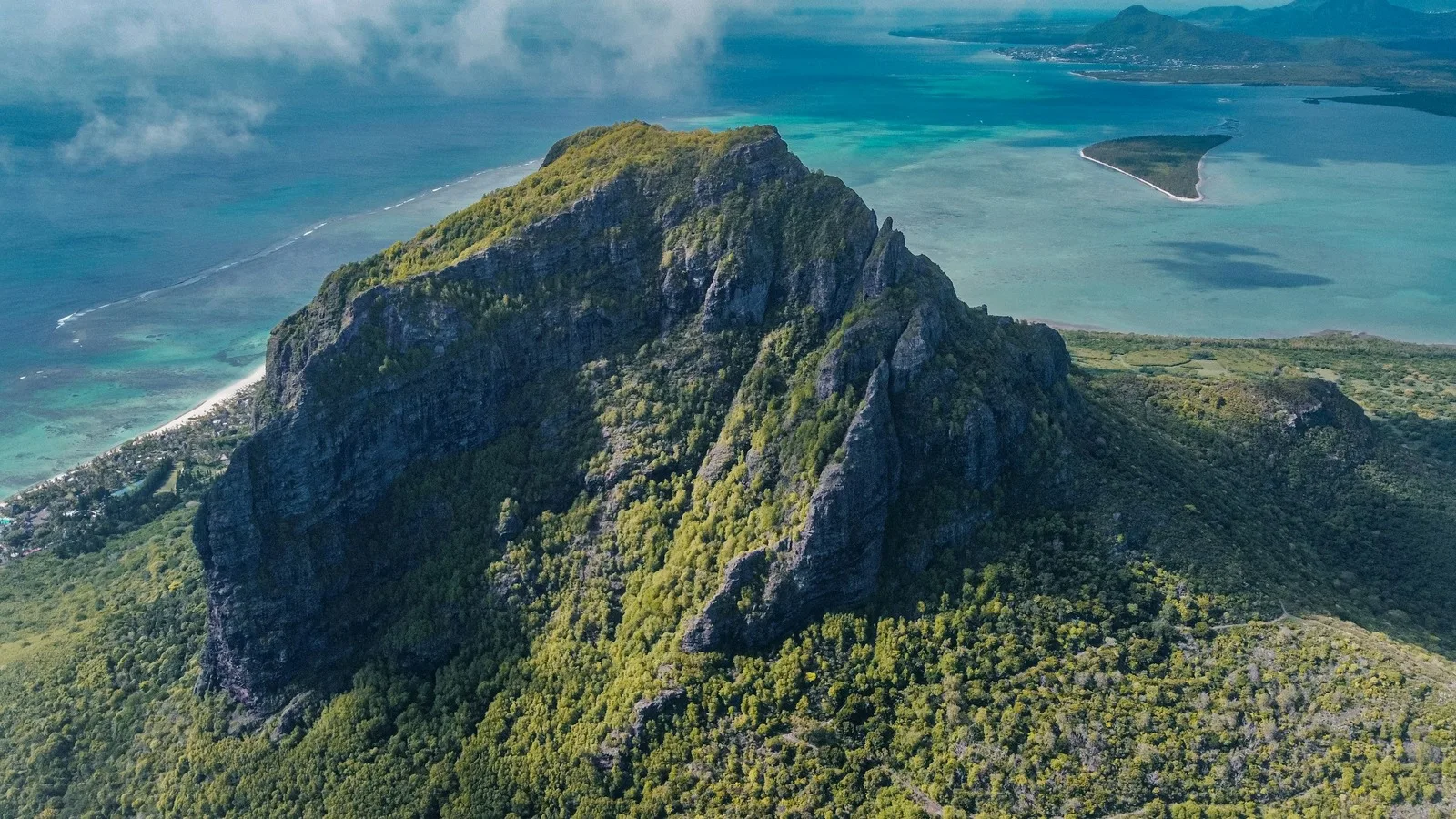
Le Morne Brabant is a basalt mountain at the south western tip of the island, and it was a refuge. Through the eighteenth century and the first years of the nineteenth, people who had escaped slavery, the maroons, formed small settlements in caves and on the summit, protected by cliffs that are wooded, isolated and close to unclimbable. UNESCO inscribed the cultural landscape in 2008, across 349.6 hectares, on the strength of the oral traditions attached to it.
The listing describes Le Morne as a symbol of the slaves’ fight for freedom, of their suffering and of their sacrifice, and connects that symbol back to the places they had been taken from: the African mainland, Madagascar, India and South East Asia. It also records that Mauritius, an important stopover in the eastern slave trade, came to be known as the Maroon republic, because of how many people were living up there.
Aapravasi Ghat
In Port Louis, on 1,640 square meters beside the harbor, stand the remains of the depot where the modern indenture system began. In 1834 the British government chose Mauritius as the first site of what it called the great experiment: the use of contracted labor in place of the enslaved labor it had just abolished. Between 1834 and 1920, close to half a million indentured workers landed here from India, to work the sugar plantations of Mauritius or to be sent on to Réunion, Australia, southern and eastern Africa, or the Caribbean.
UNESCO, which inscribed the site in 2006, describes the buildings as among the earliest explicit manifestations of what became a global economic system and one of the greatest migrations in history. A great many Mauritians can trace a family line through this gate.
Food
Mauritian food is the clearest statement the island makes about itself. Dholl puri, a thin split pea flatbread wrapped around bean curry, pickle and chilli sauce, is what everybody eats on the street and it costs almost nothing. Rougaille is a tomato based Creole braise; vindaye, fish or octopus with mustard seed and turmeric, arrived with the Indian kitchen and stayed; gateaux piments, small split pea fritters, are eaten at any hour.
Chinese Mauritian cooking is a cuisine in its own right rather than an import. What is striking is how little of this is presented to visitors as heritage. It is simply lunch.
Practical orientation
English is the official language of government and the National Assembly, French dominates the press and a good deal of daily business, and Mauritian Creole is what most people actually speak. The currency is the Mauritian rupee. The cooler, drier months run roughly from May to November, while the summer, from about November to April, is hot, humid and the cyclone season. The island is small and the bus network is cheap and slow.
Entry requirements vary by nationality and change. The Passport and Immigration Office is the authority on them, and this page is not.
Sources and references
- UNESCO World Heritage Centre: Le Morne Cultural Landscape
- UNESCO World Heritage Centre: Aapravasi Ghat
- Passport and Immigration Office, Republic of Mauritius
These are the authoritative references for the World Heritage sites this page discusses; each was checked at source on 11 August 2026. Practical details (entry rules, health guidance, opening times) change constantly. The bodies listed here are authoritative and this page is not.