Accessible Travel in Namibia
- Country Namibia
- Guide Accessibility
- Reviewed 18 August 2026
- Length 2 min read
Credit Diego Delso, CC BY-SA 4.0, via Wikimedia Commons
Last reviewed 18 August 2026
Namibia is easier than most of this region for a traveler with limited mobility, and it fails in a specific and predictable place. Understanding where the tarmac stops is most of the planning.
What works
The main roads are surfaced and the distances, while long, are driven rather than flown. Windhoek, Swakopmund and Walvis Bay are ordinary towns with ordinary infrastructure. Vehicle based touring is genuinely realistic here in a way that a delta or a walking safari elsewhere is not, and a private vehicle with a driver removes most of the difficulty at a cost that is not outrageous by regional standards.
Medical facilities in Windhoek are good, which is worth more than it sounds when you are choosing where to be based.
Where it stops: the last few kilometers
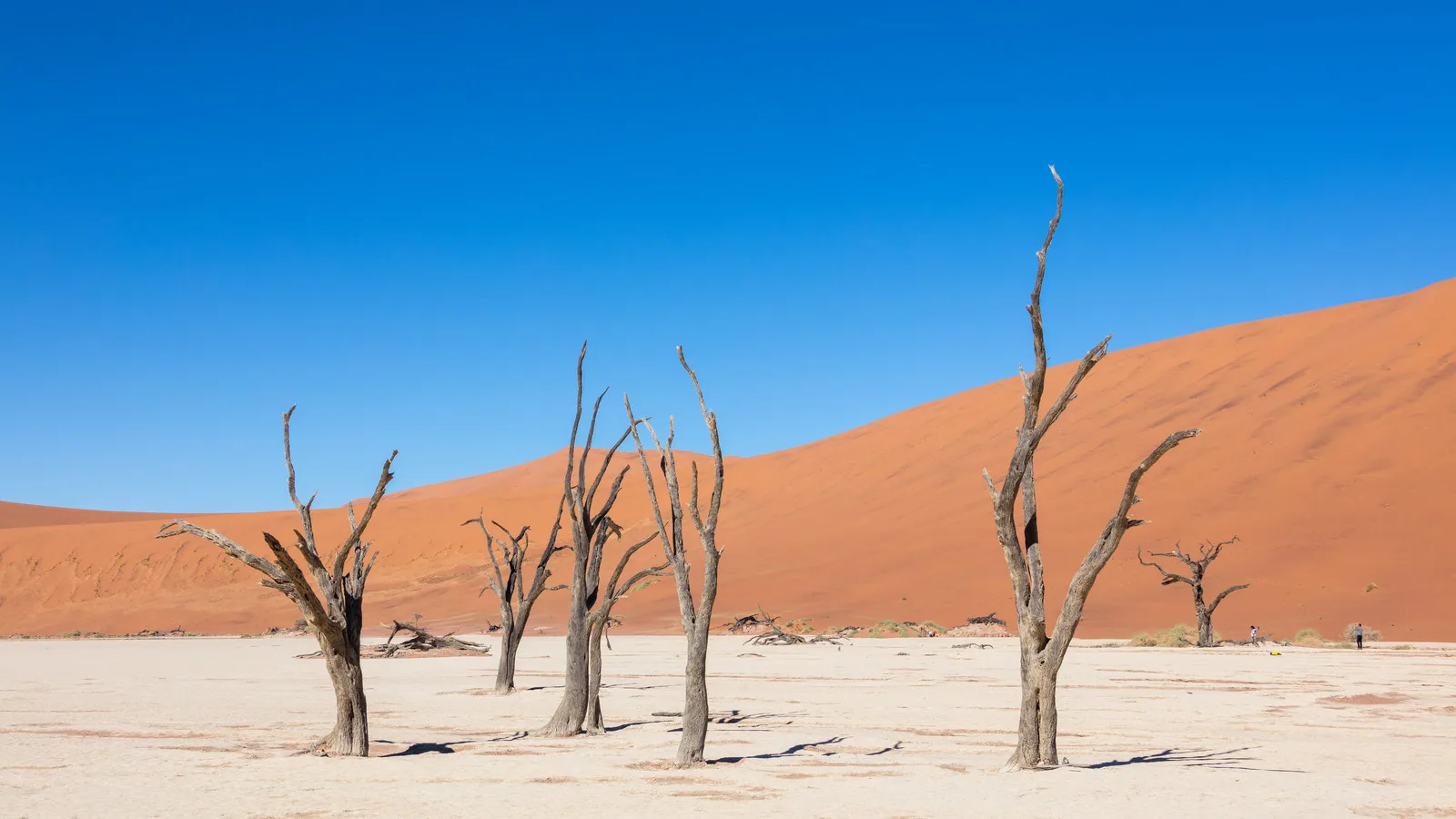
Sossusvlei is the example everyone meets. The road in is surfaced most of the way and then the final stretch to the vlei is deep sand. Two wheel drive vehicles stop at a car park and a shuttle covers the rest.
From where the shuttle drops you, Sossusvlei and Dead Vlei are reached on foot across sand, which is hard walking and impossible in a standard wheelchair. This is the honest part: the dune sea can be seen, photographed and understood from the road, from the shuttle stop and from the air. You do not have to climb anything to see it, and anyone telling you the experience requires the walk is selling the walk.
A scenic flight over the sand sea is expensive and, for some travelers, the better version of the same day.
Rock art and steep ground
Twyfelfontein and Brandberg are rock art sites on rock. Reaching the engravings involves uneven stone, steps and gradients, and guides are mandatory at Twyfelfontein. Some panels are much closer to the entrance than others. Ask which are reachable rather than assuming either that all are or that none is.
Asking well
Lodges here range from town hotels to remote camps and the difference in access is enormous. Ask concrete questions in writing: distance and surface from the parking to the room, number of steps, whether there is a level route to dinner after dark, and whether a game vehicle can be boarded without climbing.
On insurance, Namibia has a particular problem worth repeating from the safety guide: some travel policies are not recognized by some Namibian hospitals, and private hospitals may require payment before treatment. Confirm your policy is accepted here before you travel.
What to ask, and of whom
- Whether the last stretch to any site is sand, and what the alternative is
- Which rock art panels are reachable without climbing
- Distance, surface and steps between parking and room, from each lodge in writing
- Whether a game vehicle can be boarded without climbing
- Whether a scenic flight is the better version of a day for you
- Whether your insurance product is accepted by Namibian hospitals